Genetics - A. V. Sivolob 2008
The Nature of Genetic Material
DNA Repair
Direct Repair
The most obvious case of Direct Repair is the sealing of a single-strand DNA break by a ligase.
Another pathway of direct repair common to most living organisms (with the exception of mammals, for example) is so-called photoreactivation—the Cleavage of ultraviolet-induced pyrimidine dimers (Fig. 1.20) by the enzyme photolyase. Photolyase (either via its own amino acid residues or protein-bound prosthetic groups) is capable of absorbing light, which leads to enzyme activation. In other words, while light induces The formation of pyrimidine dimers, it simultaneously activates photolyase, which catalyzes the cleavage of covalent bonds between adjacent Pyrimidines (Fig. 1.20) and thereby restores the Introduction/20.html">DNA Structure.
Class="center">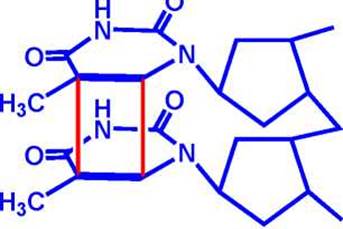
Fig. 1.20. Thymine dimer
One of the common damaging effects on DNA is the alkylation of nitrogenous bases, which involves the covalent attachment of methyl or ethyl groups to O or N atoms. Direct repair of such lesions is made possible by The activity of specific methyltransferases that remove these methyl groups.
Last update: 11/08/2026
Editorial and Educational Adaptation: This material has been compiled based on the primary/original source text. The project team performed an editorial review, corrected technical inaccuracies, structured sections, and adapted the content for an educational format.
What was processed:
- elimination of formatting defects (OCR errors, structural breaks, corrupted characters);
- editorial organization of content;
- standardization of terminology in accordance with academic sources;
- verification of factual statements against the original source text.
All mentions of the author, publication year, and origin of the primary text have been preserved in accordance with the source.