Human Anatomy - Kotsan I. Ya. 2009
Bones and Their Joints
Articulations of Bones
The initial form of bone connection (in lower vertebrates) was their fusion via connective or (later) cartilaginous tissue. However, this type of connection limits the range of motion. With The formation of movement levers, clefts and cavities began to appear in the intermediate tissue between the bones due to the resorption of the latter, resulting in a new type of bone connection — interrupted (articulation). Bones not only connected but also articulated, forming joints that allowed the skeletal levers to perform extensive movements necessary for animals, particularly those living on land. Thus, in the course of phylogenesis, two Types of bone connections evolved: the initial — continuous, with a limited range of motion, and the later — interrupted, which permitted extensive movements. Reflecting this phylogenetic process of animal adaptation to the environment through joint movements, The Development of bone connections in human Embryogenesis also passes through these two stages. Initially, the skeletal primordia are continuously linked by mesenchymal layers. The latter gradually transforms into Connective Tissue, which forms the apparatus binding the bones. If the areas of connective tissue located between the bones remain continuous, a continuous bone connection is formed — a synarthrosis. If a cavity forms within them through the resorption of connective tissue, another type of connection arises — a cavitary, or interrupted, connection, known as a diarthrosis.
Class="center">Table 5
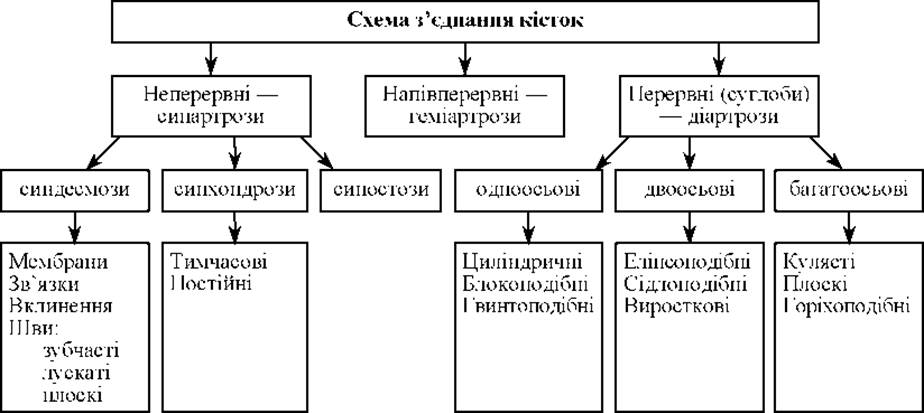
Thus, depending on their development, Structure, and function, all bone connections can be divided into three groups (Table 5):
1. Continuous connections — synarthroses — are earlier in development and are immovable or slightly movable.
2. Interrupted connections — diarthroses — are later in development and have a greater functional range of motion.
3. Semicontinuous connections — hemiarthroses or symphyses — feature a small cleft within the cartilaginous or connective tissue layer located between the connecting bones (a transitional form from continuous to interrupted connections). These connections are typically slightly movable.
Last update: 08/08/2026
Editorial and Educational Adaptation: This material has been compiled based on the primary/original source text. The project team performed an editorial review, corrected technical inaccuracies, structured sections, and adapted the content for an educational format.
What was processed:
- elimination of formatting defects (OCR errors, structural breaks, corrupted characters);
- editorial organization of content;
- standardization of terminology in accordance with academic sources;
- verification of factual statements against the original source text.
All mentions of the author, publication year, and origin of the primary text have been preserved in accordance with the source.