Human Anatomy, Part 1 - K. A. Dyubenko, A. K. Kolomiytsev, Yu. B. Chaikovsky 2002
Special Part
Thoracic Skeleton, sceleton thoracis
Sternum
The Sternum is an unpaired bone featuring a convex anterior surface and a concave posterior surface (Fig. 34). It consists of three parts: the manubrium sterni, the corpus sterni, and the processus xiphoideus.
The manubrium sterni is wider at the top and tapers toward the bottom. Its upper border presents the incisura jugularis, flanked on either side by the incisura clavicularis, which articulate the sternum with the sternal ends of the clavicles. Lower down on the lateral border lies the costal notch for the 1st rib, followed inferiorly by a small depression representing the upper part of the costal notch for the 2nd rib.
The corpus sterni is three times longer than the manubrium. The cartilaginous junction between the upper margin of the body and the manubrium is known as the manubriosternal synchondrosis. The body forms the angulus sterni with the manubrium. The lateral margins of the sternal body feature complete and incomplete costal notches, incisurae costales, for articulation with the cartilages of Ribs II–VII; however, the notches are complete only for ribs III–VI.
The processus xiphoideus is the shortest component of the sternum and varies considerably in shape. Its apex may project anteriorly or posteriorly, and it occasionally exhibits a bifid extremity or a perforation. An incomplete notch for articulation with the 7th costal Cartilage is located in its upper lateral region. The sternum contains a well-developed Cytology/practical/86.html">Red Bone Marrow, which is harvested for transplantation in cases of radiation sickness.
Ossification. The initial ossification centers in the sternum appear around the 4th–6th months in the manubrium, at 7–9 months in the body, and at approximately 25 years of age in the xiphoid process. Expansion of the ossification centers within the sternal body occurs between 15 and 20 years of age. The xiphoid process fuses with the body of the sternum after the age of 30, and the manubrium fuses after 40.
Class="center">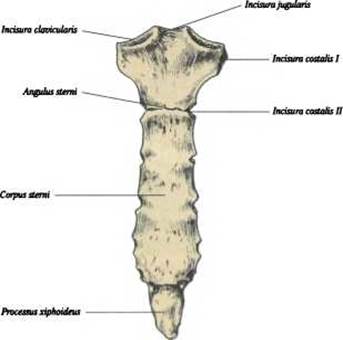
Fig. 34. The sternum
Last update: 08/08/2026
Editorial and Educational Adaptation: This material has been compiled based on the primary/original source text. The project team performed an editorial review, corrected technical inaccuracies, structured sections, and adapted the content for an educational format.
What was processed:
- elimination of formatting defects (OCR errors, structural breaks, corrupted characters);
- editorial organization of content;
- standardization of terminology in accordance with academic sources;
- verification of factual statements against the original source text.
All mentions of the author, publication year, and origin of the primary text have been preserved in accordance with the source.