Plant Physiology - Musiyenko M.M. 2001
General principles of plant growth and morphogenesis regulation
Brassinins (brassinosteroids) and other phytohormone-like compounds
Brassinosteroids were first discovered in the pollen of rapeseed (Brassica napus), which is THE ORIGIN OF their name. It was established that this is a steroidal substance with the molecular formula C28H48O6. This compound was named brassinolide:
Class="center">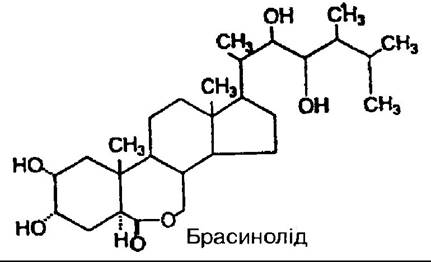
Later on, it turned out that A number of other similar compounds also exhibit growth-regulating activity. Therefore, their collective name is brassinosteroids. They occur in various plant Organs, but most frequently and in significant amounts in pollen. Brassinosteroids show high biological activity, stimulating the growth of various plant organs (both Cell Division and elongation growth). There is evidence that treating plants with brassinosteroids can enhance their resistance to unfavorable environmental conditions. The physiological nature of their action remains unknown; however, their widespread occurrence and high biological activity lead some researchers to classify them as phytohormones.
Another substance whose mode of action is similar to that of phytohormones is fusicoccin:
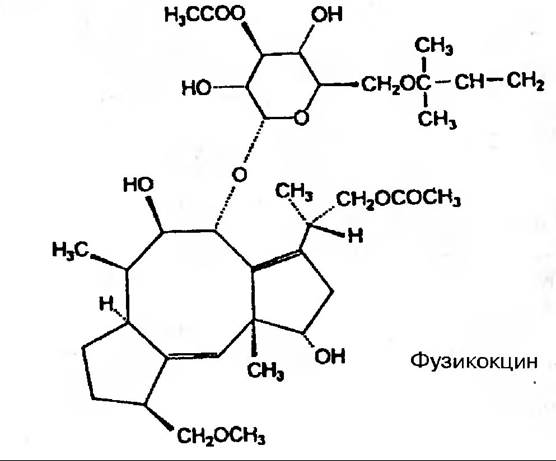
It is a metabolite of the fungus Fusicoccin amygdali and possesses high, versatile biological activity. Similarly to Gibberellins, fusicoccin belongs to the same group of chemical compounds—Diterpenes, and is also produced by phytopathogenic Fungi. G.S. Muromtsev (Russia) suggested that fusicoccin has a hormonal nature, searched for these substances in higher plants, and detected them in the roots and cobs of corn as well as in cabbage leaves. It induces cell elongation in many plant Tissues (even more actively than auxin) and causes stomatal opening both in the presence of light and in the dark. Fusicoccin stimulates seed germination and promotes ROOT formation, which is of significant practical interest for crop production.
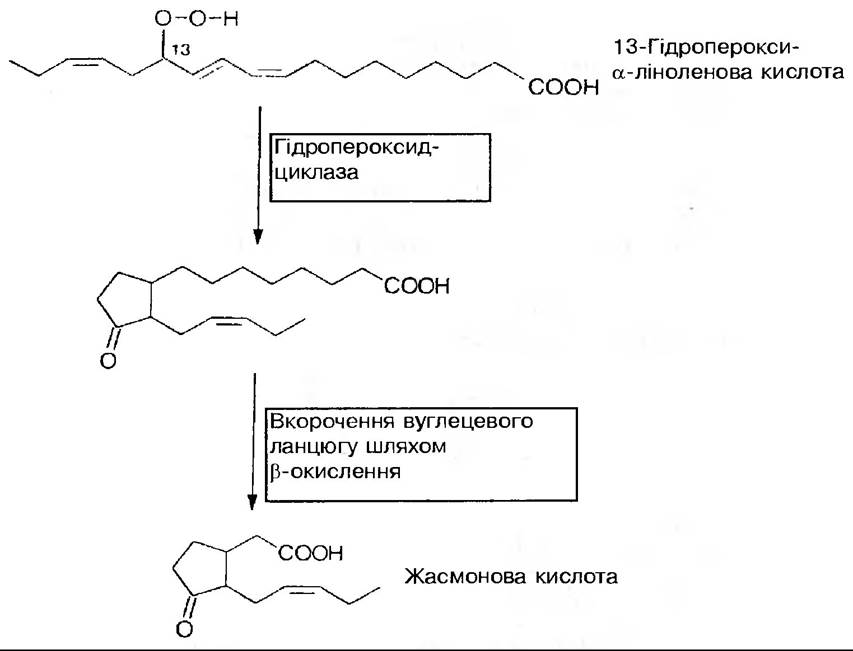
Jasmonic acid, which also exhibits phytohormone-like properties, has been identified in more than 200 plant genera. Its physiological Functions in vivo are still poorly understood, but it has been established that exogenous jasmonic acid (at a concentration of 10-6–10-4 mol×L-1) inhibits growth processes and stimulates senescence in isolated leaves and fruits. Jasmonic acid is synthesized with the participation of hydroperoxide cyclase via the β-oxidation of hydroperoxylinolenic acid:
All this indicates that, In addition to the 5 classes of phytohormones we have examined, plant organisms may contain other constituent components that possess phytohormonal activity.
Last update: 07/08/2026
Editorial and Educational Adaptation: This material has been compiled based on the primary/original source text. The project team performed an editorial review, corrected technical inaccuracies, structured sections, and adapted the content for an educational format.
What was processed:
- elimination of formatting defects (OCR errors, structural breaks, corrupted characters);
- editorial organization of content;
- standardization of terminology in accordance with academic sources;
- verification of factual statements against the original source text.
All mentions of the author, publication year, and origin of the primary text have been preserved in accordance with the source.