BIOLOGY Volume 3 - A Guide to General Biology - 2004
24. VARIATION AND GENETICS
24.7. Gene Interaction
24.7.3. Lethal Genes
There are instances where a single Gene can influence multiple traits, including viability. In humans and other mammals, a specific recessive gene causes The formation of internal lung adhesions, resulting in death at birth. Another example is a gene that affects Cartilage formation and causes Congenital Malformations leading to fetal or neonatal death.
In chickens homozygous for the allele causing "frizzled" feathers, incomplete feather development leads to several phenotypic effects. These chickens suffer from poor thermal insulation and excessive heat loss. This heat loss is compensated for by a series of structural and physiological adaptations which, however, are largely ineffective, resulting in a high mortality rate among these birds.
A striking example of a lethal gene effect is the inheritance of coat color in mice. Wild mice typically have agouti-colored fur, but some mice are yellow. When yellow mice are crossed with each other, the offspring consist of both yellow and agouti mice in a 2:1 ratio. The only plausible explanation for these results is that the yellow coat color is dominant to agouti and that all surviving yellow mice are heterozygous. The atypical ratio is due to the fact that homozygous yellow mice die before birth (Fig. 24.25). Dissection of pregnant yellow females mated with yellow males revealed dead yellow fetuses in their uteri. Conversely, when yellow mice were crossed with agouti mice, no dead yellow fetuses were found in the uteri of the pregnant females, since such a cross cannot produce offspring homozygous for the yellow coat color gene (YY).
Class="center">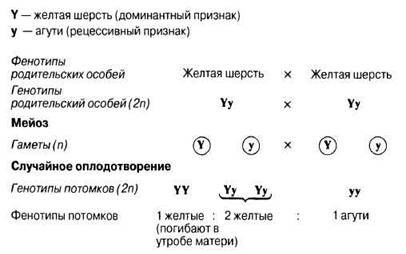
Fig. 24.25. Genetic explanation of coat color inheritance in mice. The results of the cross indicate the lethality of the YY genotype.
Last update: 06/08/2026
Editorial and Educational Adaptation: This material has been compiled based on the primary/original source text. The project team performed an editorial review, corrected technical inaccuracies, structured sections, and adapted the content for an educational format.
What was processed:
- elimination of formatting defects (OCR errors, structural breaks, corrupted characters);
- editorial organization of content;
- standardization of terminology in accordance with academic sources;
- verification of factual statements against the original source text.
All mentions of the author, publication year, and origin of the primary text have been preserved in accordance with the source.