BIOLOGY Volume 3 - A Guide to General Biology - 2004
25. APPLIED GENETICS
25.1. Bacterial Genetic Engineering
25.1.6. Selection of Bacteria Containing the Desired Gene
If the 'shotgun' approach was used in The First stage of cloning, the Bacteria that have taken up the donor DNA will not necessarily carry the DNA fragment with the target Gene. The donor DNA is a mixture of a very large number of restriction fragments (up to a million in the case of human DNA). Even when all these fragments are cloned, only one or a few of them will contain the desired gene or DNA segment. A mixture of clones obtained in this way is called a library. A library can also be constructed by using Reverse Transcriptase and an mRNA mixture in the initial stage. Sometimes this is necessary if the required mRNA cannot be isolated in pure form. Thus, in cases where a single gene was not cloned (either synthesized or read from a single type of mRNA), bacterial cultures are obtained as libraries following the Fourth Stage.
Use of Probes
The desired bacterium is selected using a probe, as shown in Fig. 25.9. A probe can be used if the complete or partial DNA sequence of the target is known. Alternatively, if the Amino Acid Sequence of the protein encoded by the gene is known, The nucleotide sequence can be predicted from it (or at least one very close to it). Short DNA and RNA fragments are used as probes; because they are complementary to a region of the desired gene, they bind to it. For example, the probe AGTCCA will locate and hydrogen-bond to the sequence TCAGGT. Probes can be very short (15–20 NUCLEOTIDES) or longer. Typically, probes are synthesized using nucleotides labeled with the radioactive isotope 32P. When the probe binds to the DNA, the radioactivity serves as a marker that is detected by autoradiography (Fig. 25.9).
Class="center">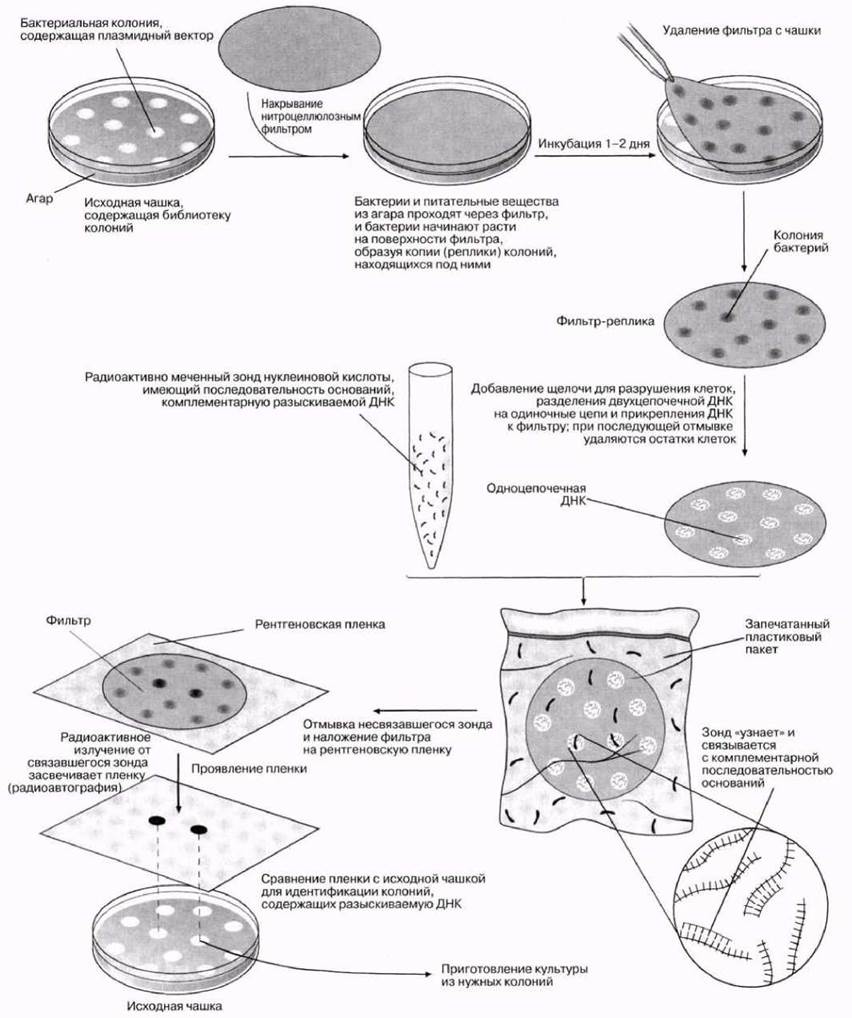
Fig. 25.9. Screening a library using a DNA probe to identify a clone.
Last update: 06/08/2026
Editorial and Educational Adaptation: This material has been compiled based on the primary/original source text. The project team performed an editorial review, corrected technical inaccuracies, structured sections, and adapted the content for an educational format.
What was processed:
- elimination of formatting defects (OCR errors, structural breaks, corrupted characters);
- editorial organization of content;
- standardization of terminology in accordance with academic sources;
- verification of factual statements against the original source text.
All mentions of the author, publication year, and origin of the primary text have been preserved in accordance with the source.