BIOLOGY Volume 2 - A Guide to General Biology - 2004
18. THE ANIMAL SKELETOMUSCULAR SYSTEM
18.6. Locomotion in Vertebrates
18.6.4. Locomotion in Quadrupeds (Using the Dog as an Example)
Walking
During walking, a dog's spine remains rigid, and forward propulsion is provided by the hind limbs. They move forward and backward through the contraction of flexors and extensors, respectively.
When the extensors contract, the hind paw acts as a lever; it straightens and pushes off the ground, propelling the animal's body forward and lifting it slightly. When the flexors contract, the paw leaves the ground and moves forward. At any given moment, only one paw is raised, while the other three serve as support to keep the body balanced. If a stationary dog begins to move forward starting with the left front leg, the subsequent leg movements follow this sequence: right hind, right front, left hind, left front again, and so on.
Running
When running, a dog ceases to rely on three legs simultaneously; it shifts to a different gait in which both front legs move together, followed by both hind legs. The paws spend significantly less time on the ground than during a walk, and typically one forelimb leads the other by a fraction of a second. The same applies to the hind limbs. Therefore, the paws Touch the ground in the following sequence: left front, right front, right hind, left hind, and so on.
If the dog reaches maximum speed, leg movements accelerate, and all four legs can leave the ground simultaneously after extension. Powerful trunk Muscles arch the spine upward when the legs are bent, and flex it downward when the legs are fully extended. This enhances the force of the push-off and noticeably lengthens the stride, both of which contribute to running speed (Fig. 18.29).
Class="center">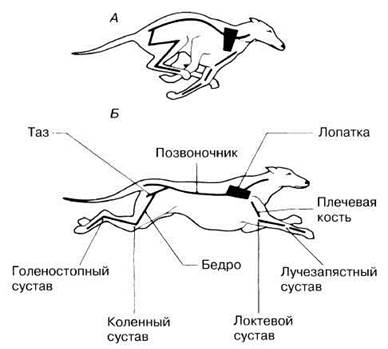
Fig. 18.29. Sequence of movements in a running dog (using a greyhound as an example). A. Spine arched, paws positioned directly beneath the body. B. Spine fully straightened (even slightly sagging downward); limbs fully extended.
Last update: 06/08/2026
Editorial and Educational Adaptation: This material has been compiled based on the primary/original source text. The project team performed an editorial review, corrected technical inaccuracies, structured sections, and adapted the content for an educational format.
What was processed:
- elimination of formatting defects (OCR errors, structural breaks, corrupted characters);
- editorial organization of content;
- standardization of terminology in accordance with academic sources;
- verification of factual statements against the original source text.
All mentions of the author, publication year, and origin of the primary text have been preserved in accordance with the source.