BIOLOGY Volume 2 - A Guide to General Biology - 2004
15. HEALTH AND DISEASE
15.3. Infectious Diseases
15.3.6. Salmonellosis and Other Bacterial Food Poisoning
Food poisoning is generally understood to mean bacterial intestinal infections (infectious gastroenteritis) with an incubation period lasting just a few hours. Many of these are caused by salmonellae—not S. typhi and S. paratyphi, but other species such as S. enteritidts. Since the symptoms of these infections are broadly similar, they are grouped under a single heading: salmonellosis. The economic impact of salmonellosis is substantial. For instance, between 1988 and 1989, England and Wales lost between £231 million and £331 million due to salmonellosis, costs incurred through sick leave, medical Treatment, and scientific research.
Unlike typhoid fever, salmonellosis has a low infectivity rate, meaning that A large number of pathogens must enter the body for the infection to develop. It also differs in this respect from gastroenteritis caused by the bacterium Escherichia coli O157, which has increasingly become a cause of food poisoning in recent times. Outbreaks of foodborne infections can likewise be triggered by other Bacteria. For example, Listeria monocytogenes, frequently found in pâtés and soft cheeses, causes Listeriosis. Aside from the microorganisms mentioned above, Staphylococcus aureus (Staphylococcus aureus) and certain members of the genera Bacillus and Clostridium pose significant risks, though discussing them falls outside The Scope of this book.
At the turn of the 1990s, Britain experienced several outbreaks of salmonellosis. The causative agent was most frequently S. enteritidts (accounting for 53% of infection cases in 1989 and 63% in 1991), with eggs and poultry typically serving as the source of infection.
Figure 15.12 illustrates the prevalence trends in Britain of salmonellosis caused by S. enteritidis present in eggs. Despite rigorous sanitary controls at poultry farms, contamination among domestic poultry actually increased after 1988.
Class="center">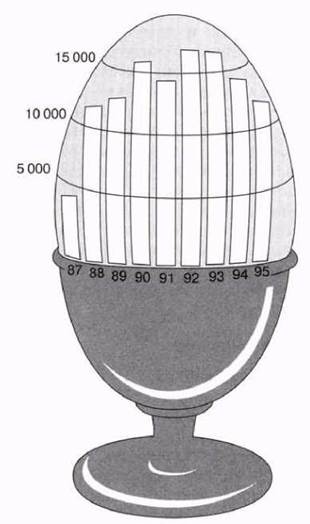
Fig. 15.12. Number of food poisoning cases in Britain caused by Salmonella enteritidis found in eggs (1987–1995) (From The Times, 23rd March 1996.)
Routes of Transmission and Symptoms
Salmonellosis is a classic example of a foodborne illness. Table 15.9 lists the types of foods that caused outbreaks of this intestinal infection between 1989 and 1991, and reflects the relative role of S. enteritidis in these outbreaks. Salmonellosis affects not only humans but also domestic animals and poultry whose meat is consumed by people. Furthermore, There is a constant risk of food contamination from the feces of rats, mice, cats, and dogs.
Table 15.9. Foods responsible for salmonellosis outbreaks between 1989 and 1991 (Communicable Disease Report vol. 3, Review no. 12, 5 Nov. 1993, Public Health Laboratories Service)
Food Item |
Number of outbreaks caused by Salmonella enteritidis |
Total number of salmonellosis outbreaks |
Chicken |
16 |
23 |
Turkey |
5 |
21 |
Beef |
3 |
7 |
Pork or ham |
- |
5 |
Cold meats |
2 |
7 |
Other meat dishes (including pies) |
8 |
24 |
Gravies and sauces |
1 |
1 |
Milk |
- |
3 |
Other dairy products |
- |
1 |
Eggs |
45 |
50 |
Vegetables and salads |
- |
1 |
Bread and rolls |
3 |
7 |
Confectionery, including puddings |
20 |
21 |
Mixed dishes |
42 |
47 |
Other/not ascertained* |
114 |
174 |
Total |
259 |
392 |
* Including 12 outbreaks suspected to be of foreign travel origin |
||
Symptoms of salmonellosis appear abruptly, 12–24 hours after the bacteria enter the digestive tract. They are typically characterized by vomiting and diarrhea accompanied by high fever, headache, and abdominal discomfort. Most patients recover spontaneously within a few days.
Diarrhea carries the risk of dehydration, which in turn can lead to a drop in Blood pressure and renal failure. The majority of fatalities from bacterial gastroenteritis are linked specifically to these complications. Salmonellosis is most dangerous for young children and the elderly. For an accurate Diagnosis in all cases, stool cultures and identification of the causative agent are required.
Treatment and Prevention
Treatment for salmonellosis is supportive (replacement of fluids and electrolytes) and medicinal. Antibiotics, particularly Tetracyclines and ampicillin, are effective against the pathogen, but they do not shorten the duration of the acute phase. Recently, strains of salmonellae resistant to traditionally used drugs have begun to emerge.
Prevention involves several key measures.
1. Detection of carriers. A certain segment of the population (approximately 2–5 people per thousand) act as carriers, meaning they shed salmonellae in their feces without experiencing any symptoms of gastroenteritis. Carriers and convalescing patients must not be allowed to handle food until stool tests confirm the absence of pathogens in their bodies.
2. Compliance with hygiene and sanitation rules in food storage and Processing. Food must be kept cold, which slows down bacterial growth. Exceptional cleanliness is required in kitchens, where certain types of food—such as raw meat (especially poultry) and eggs—must be prepared separately from other foods to avoid cross-contamination. Cutting boards, towels, kitchen equipment, and human hands can all serve as reservoirs for salmonellae and sources of their spread. Public health inspectors are responsible for checking catering establishments, shops, and warehouses.
3. Proper food preparation. Food preparation must ensure bacteriological safety. First and foremost, this involves thoroughly cooking certain food products. Inadequately thawed meat poses a major hazard, as bacteria can survive in the center during frying or boiling. In 1988, the UK Department of Health recommended that individuals at high risk of salmonellosis—namely the elderly, the sick, infants, and pregnant women—consume only hard-boiled eggs.
4. Meat inspection by health authorities is a mandatory requirement before sale. Sending livestock infected with salmonellosis to slaughterhouses is strictly prohibited. A low level of salmonella presence on poultry farms is considered inevitable, which is why culling entire flocks is ordered there only in the event of a severe outbreak.
5. Mandatory reporting of all food poisoning cases. Bacterial foodborne illness is a notifiable disease. According to statistics, the prevalence of food poisoning in the UK reached its highest level since 1949 in 1995, with 80,000 reported cases compared to 63,000 in 1992. Regular tracking of all infected individuals is essential for implementing effective preventive measures.
6. Rodent control, as their droppings may harbor salmonellae.
7. Timely sewage repairs (see the sections on typhoid and cholera).
8. Vector control targeting flies (see the sections on typhoid and cholera).
9. Government oversight. In 1989, the British government took decisive action to curb the spread of salmonellosis. Screening poultry farms for pathogens became mandatory, resulting in the culling of over 3 million infected laying hens. Furthermore, the Food Safety Act of 1990 imposed stricter microbiological standards.
Last update: 06/08/2026
Editorial and Educational Adaptation: This material has been compiled based on the primary/original source text. The project team performed an editorial review, corrected technical inaccuracies, structured sections, and adapted the content for an educational format.
What was processed:
- elimination of formatting defects (OCR errors, structural breaks, corrupted characters);
- editorial organization of content;
- standardization of terminology in accordance with academic sources;
- verification of factual statements against the original source text.
All mentions of the author, publication year, and origin of the primary text have been preserved in accordance with the source.