BIOLOGY Volume 1 - A Guide to General Biology - 2004
7. AUTOTROPHIC NUTRITION
7.5. Photosynthetic Pigments
7.5.5. Photosystems
Chlorophyll and accessory pigment molecules are organized into Photosystems, which are divided into two types: Photosystem I and II (PSI and PSII). These photosystems appear as distinct particles embedded within the thylakoid membranes (Fig. 7.12). Each such particle contains pigment molecules arranged into what is known as an antenna complex or light-harvesting complex.
Class="center">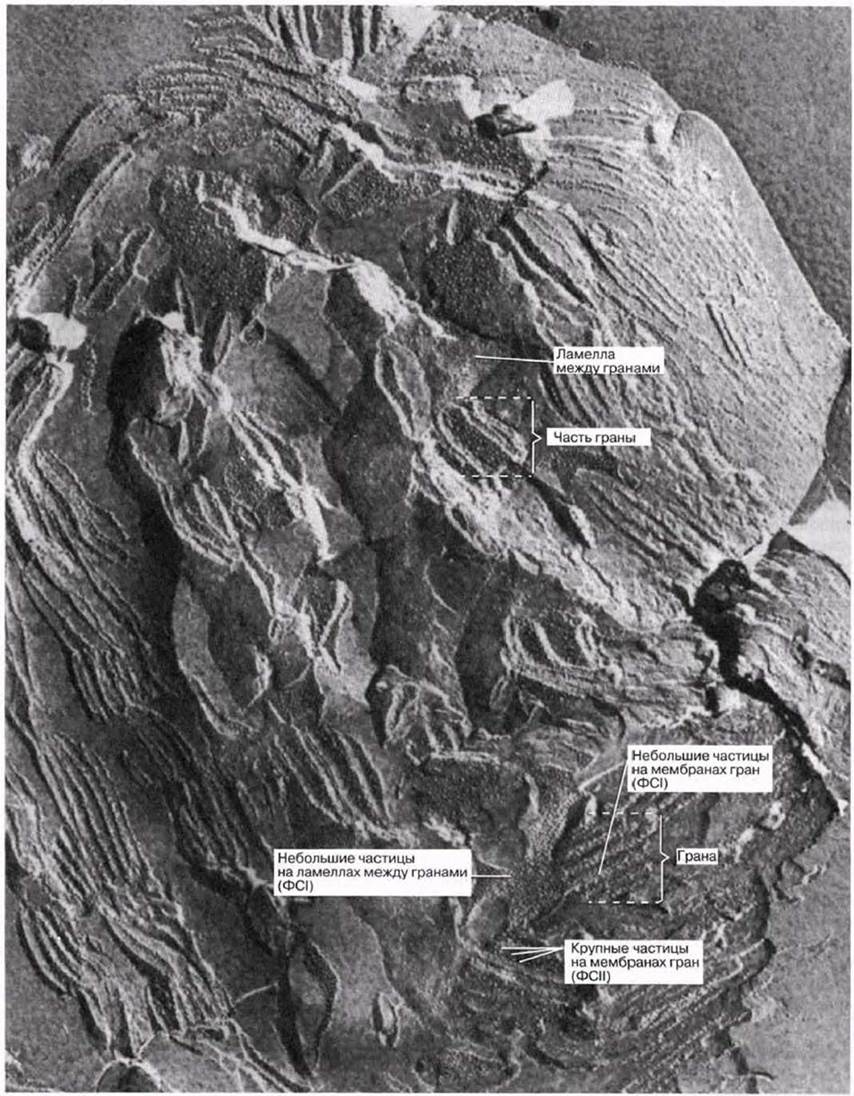
Fig. 7.12. Chloroplast thylakoids obtained by freeze-fracture Replication, showing the fractured membrane surface. Note the particles studding the membrane surface, which represent the photosystems. PSI particles are smaller than PSII particles.
The light-harvesting complex comprises 200–300 pigment molecules that capture light energy, as illustrated in Fig. 7.13. Different pigments absorb light at varying wavelengths, thereby increasing the efficiency of the process. The absorbed energy is funneled from molecule to molecule until it ultimately reaches a specialized form of chlorophyll a, designated as P700 in PSI and P680 in PSII. P700 and P680 are pigment molecules (P) whose absorption peaks lie at 700 and 680 nm, respectively (both peaks falling within the red region of the spectrum).

Fig. 7.13. Schematic representation of a photosystem. Light can be absorbed by any pigment molecule within the light-harvesting complex. The photosystem is located in the thylakoids. The Two Types of photosystems are visible in Fig. 7.12 as particles of two different sizes.
Upon energy absorption, the chlorophyll molecules P700 and P680 enter an "excited" state and serve as sources of high-energy electrons (as described above). The subsequent fate of these electrons will be discussed below (Section 7.6.2). We can now examine the overall process of Photosynthesis.
Last update: 06/08/2026
Editorial and Educational Adaptation: This material has been compiled based on the primary/original source text. The project team performed an editorial review, corrected technical inaccuracies, structured sections, and adapted the content for an educational format.
What was processed:
- elimination of formatting defects (OCR errors, structural breaks, corrupted characters);
- editorial organization of content;
- standardization of terminology in accordance with academic sources;
- verification of factual statements against the original source text.
All mentions of the author, publication year, and origin of the primary text have been preserved in accordance with the source.