Biochemistry - The Chemical Reactions of Living Cells Volume 3 - D. Metzler 1980
Biochemical Genetics and the Synthesis of Nucleic Acids and Proteins
Mutations, Cancer, and Genetic Engineering
Environmental Mutagens
Human exposure to mutagenic substances is a growing cause for concern. Industry introduces over 500 new chemical compounds every year. Some of these, widely used as Pharmaceuticals such as hycanthone (Fig. 2-27), exhibit mutagenic activity. Potent mutagens are also found in A number of food products [253]. Aflatoxins, dangerous carcinogens synthesized by Aspergillus flavus, may contaminate peanuts and other edible goods.
Class="center">
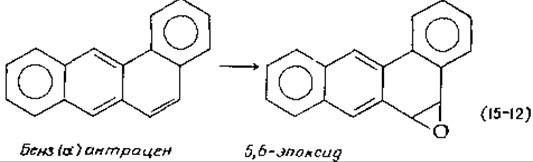
Many carcinogenic and mutagenic compounds do not display unusual chemical reactivity under standard conditions. However, within the animal body, they frequently undergo hydroxylation, thereby converting into mutagens. An example is The formation of carcinogenic epoxide derivatives from aromatic Hydrocarbons [equation (15-12)] [244,254].
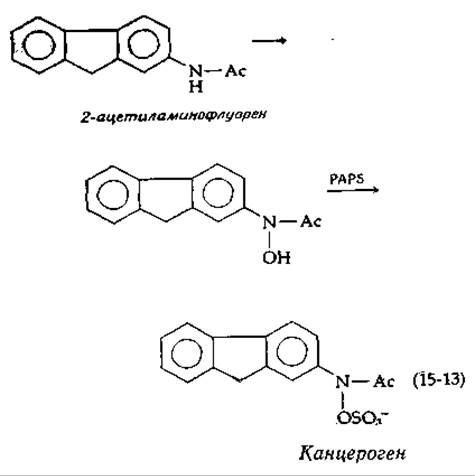
Another example is The conversion of 2-acetylaminofluorene into the N-sulfate [equation (15-13)] [255].
How can a mutagenic compound be identified? A highly valuable method based on bacterial test strains was developed by Ames and co-workers, who used Salmonella mutants unable to synthesize their own Histidine but capable of growing when a mutagenic agent induces a back-mutation. Mutations in one such strain can be induced by base-substitution agents. Three other strains, carrying Different types of frameshift mutations, respond selectively to various mutagens. Approximately 109 Bacteria are plated in a Petri dish, and a small amount of the mutagenic compound is applied to the center. Bacterial colonies develop in the areas where reverse mutations occur. All of these strains are defective in the primary DNA excision-repair system, preventing the repair of most mutations and rendering the assay exceptionally sensitive. The addition of a Liver homogenate along with an NADPH-generating system allows many Aromatic Compounds to be "activated" via hydroxylation [256]. Careful application of these assays, combined with long-term animal testing, can help us maintain a relatively low mutation rate. Nevertheless, the accumulation of deleterious mutations—whether arising naturally or resulting from prior exposure to chemical agents or radiation—already constitutes a serious challenge [257, 257a].
Last update: 06/08/2026
Editorial and Educational Adaptation: This material has been compiled based on the primary/original source text. The project team performed an editorial review, corrected technical inaccuracies, structured sections, and adapted the content for an educational format.
What was processed:
- elimination of formatting defects (OCR errors, structural breaks, corrupted characters);
- editorial organization of content;
- standardization of terminology in accordance with academic sources;
- verification of factual statements against the original source text.
All mentions of the author, publication year, and origin of the primary text have been preserved in accordance with the source.