Biochemistry - The Chemical Reactions of Living Cells, Volume 2 - D. Metzler 1980
Types of Reactions Catalyzed by Enzymes
Substitution at the Phosphorus Atom
Adenylyl Cyclase and Cyclic AMP
The formation of 3',5'-cyclic AMP (cAMP) occurs when the 3'-hydroxyl group of the ribose ring replaces the internal phosphorus atom ($ ext{P}_ ext{a}$) of ATP (stage a in the scheme below):
Class="center">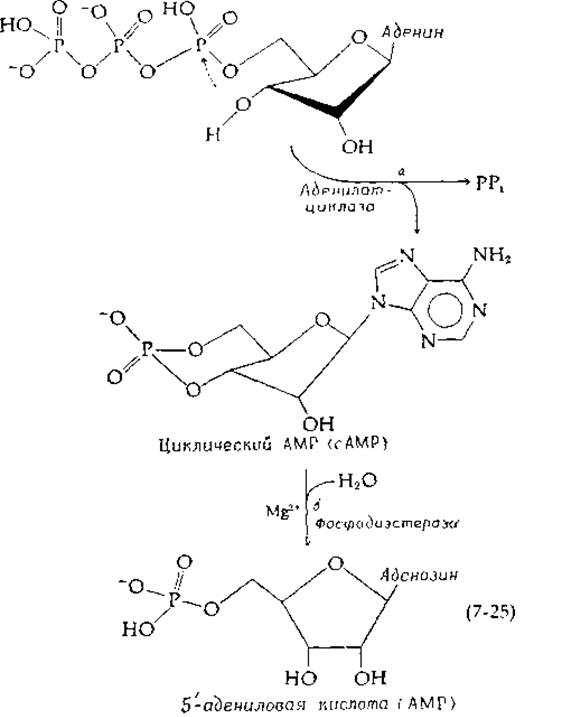
The unique properties of adenylate cyclase [85] and the related guanylate cyclase [86] have already been discussed in previous chapters (Chapter 5, Section B.5; Chapter 6, Section E.5). From a kinetic standpoint, the cyclic AMP molecule is exceptionally stable; however, from a thermodynamic perspective (regarding the potential Hydrolysis of this compound), it is unstable. Specific phosphodiesterase catalyzes the Cleavage of cAMP to yield 5'-adenylic acid [AMP; stage b in equation (7-25)]. Two successive reactions in equation (7-25) account for the formation and degradation of cAMP. Note the striking similarity between this reaction sequence and the two Stages of the reaction (7-19) catalyzed by Ribonuclease.
Last update: 06/08/2026
Editorial and Educational Adaptation: This material has been compiled based on the primary/original source text. The project team performed an editorial review, corrected technical inaccuracies, structured sections, and adapted the content for an educational format.
What was processed:
- elimination of formatting defects (OCR errors, structural breaks, corrupted characters);
- editorial organization of content;
- standardization of terminology in accordance with academic sources;
- verification of factual statements against the original source text.
All mentions of the author, publication year, and origin of the primary text have been preserved in accordance with the source.