Biochemistry: The Chemical Reactions of Living Cells, Volume 2 - D. Metzler 1980
Coenzymes are specialized natural reagents of a unique kind.
Coenzyme forms of vitamin B12
Substrate isomerization
How does the substrate isomerize in step b of equation (8-77)? Any intermediate compounds are possible: a radical [164], a carbonium ion, and a carbanion [164a]. For diol dehydratase, Cleavage of the Co—C bond is possible with The formation of B12s and a carbocation [equation (8-79)]. The carbocation would likely undergo cyclization to an epoxide, capable of reacting further with B12s [step b in equation (8-79)], thus completing the isomerization. On the other hand, the elimination of OH- can lead to an equilibrium mixture of the cobalt-bound carbocation and a cobalt—olefin π-complex [178a].
Class="center">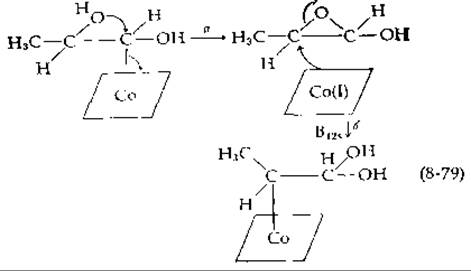
In the case of methylmalonyl-CoA mutase, Ingram proposes the cleavage of the Co—C bond with the formation of a carbanion, where the substrate-cobalamin compound acts as a "biological Grignard reagent". The carbanion can be stabilized by the carbonyl group of the thioester to form a "homoenolate anion" [equation (8-80)]:
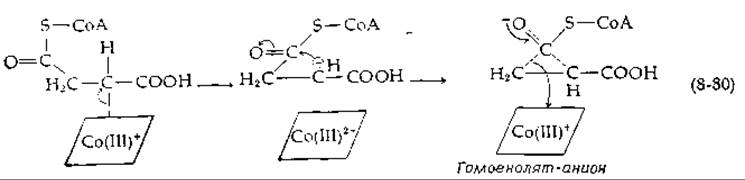
The latter could decompose via one of two pathways, leading to the regeneration of the initial Co—C bond and the isomerization of the substrate [179, 180].
In the case of Ribonucleotide reductase, It is interesting to determine whether the Co(II) intermediate reacts with the 3'-carbon atom of the ribonucleotide substrate, initiating reduction, and whether the 5'-deoxyadenosyl radical abstracts a proton from the reduced thioredoxin to form a sulfide radical (—S•), or whether both processes are possible. Much in this matter remains unclear.
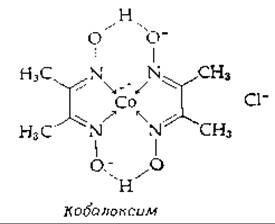
Interesting non-enzymatic model systems are also being investigated. The non-enzymatic rearrangement of a B12 derivative with a Co—C bond has been observed [181]. Other studies are based on complexes termed cobaloximes [182]. A cobaloxime is a complex of Co3+ and two molecules of dimethylglyoxime. When such a compound is coordinated with a suitable basic group in one of the axial positions, it closely resembles vitamin B12. It can be reduced to the Co(II) state and can react with alkyl halides to form alkylcobaloximes, which are analogous in many properties and chemical reactivities to the Coenzyme forms of Vitamin B12.
Last update: 06/08/2026
Editorial and Educational Adaptation: This material has been compiled based on the primary/original source text. The project team performed an editorial review, corrected technical inaccuracies, structured sections, and adapted the content for an educational format.
What was processed:
- elimination of formatting defects (OCR errors, structural breaks, corrupted characters);
- editorial organization of content;
- standardization of terminology in accordance with academic sources;
- verification of factual statements against the original source text.
All mentions of the author, publication year, and origin of the primary text have been preserved in accordance with the source.