Biochemistry - Chemical Reactions in Living Cells, Volume 1 - D. Metzler 1980
How molecules combine with each other
Cooperative conformational changes
Unequal substrate binding and induced fit
Let us assume that conformer B binds to X more tightly than conformer A (as illustrated in the diagram above, where the shapes of the binding sites of the two conformers differ). The true binding constants of conformers A and B with molecule X — denoted as KAX and KBX (or KT and KR) — are equal, respectively, to
Class="center">
All equilibrium processes occurring in this system are presented below.
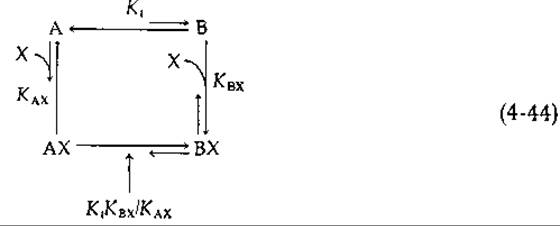
Note that the constant characterizing the equilibrium between AX and BX is a function of three other constants, namely KtKBX/KAX. Now let us consider the following scenario. Suppose that in the absence of X, form A predominates, yet X binds much more strongly to B than to A. In this case, the equilibrium mixture will consist predominantly of either free A or BX (with smaller amounts of AX and B also present). This raises an interesting kinetic question: along which of the two possible pathways will the transition reaction from A to BX proceed [equation (44)]? The first option, assumed in the Monod–Wyman–Changeux model, posits that X binds exclusively to form B, a small amount of which is present in the mixture in equilibrium with A. According to the second option, X binds to A, after which AX rapidly converts into BX. In a sense, X induces a conformational change in protein A that facilitates "docking." This forms The basis of Koshland's concept, known as the induced-fit model. It should be borne in mind that knowing the equilibrium constants allows one to determine only the equilibrium concentrations of all four forms present in equation (4-44). However, when studying METABOLISM, we are usually more interested in reaction rates than in the state of equilibrium, and solely on the basis of equilibrium data, it is impossible to predict a priori which of the two possible pathways the reaction will actually follow.
Note that if the ratio KBX/KAX is very large, only a negligible amount of AX will be present in the equilibrium mixture. In this case, determining the value of KAX experimentally is not feasible, but to describe The equilibrium state, knowing just two constants — KT and KBX — is sufficient.
Last update: 06/08/2026
Editorial and Educational Adaptation: This material has been compiled based on the primary/original source text. The project team performed an editorial review, corrected technical inaccuracies, structured sections, and adapted the content for an educational format.
What was processed:
- elimination of formatting defects (OCR errors, structural breaks, corrupted characters);
- editorial organization of content;
- standardization of terminology in accordance with academic sources;
- verification of factual statements against the original source text.
All mentions of the author, publication year, and origin of the primary text have been preserved in accordance with the source.