Principles of Biochemistry, Volume 3 - A. Lehninger 1985
Selected Aspects of Human Biochemistry
Human Nutrition
Many food products contain little ascorbic acid
For centuries, it has been known that scurvy—a disease common among sailors and travelers who relied on preserved foods—can be cured by providing patients with certain plant foods or fruit and vegetable juices. One of the earliest accounts of treating this disease appears in the journals of Jacques Cartier (Supplementary 26-1), who traveled through Newfoundland and the St. Lawrence River as early as the mid-16th century. However, it took more than two centuries before the effectiveness of scurvy Treatment was proven through systematic experimentation. In the 1760s, James Lind attempted to treat a group of sailors suffering from scurvy using six different diets. Only one of them, which included lemon juice, produced a positive effect. Lind established that fresh greens, various vegetables, and fruits—especially citrus fruits—can help cure scurvy. Despite Lind recommending the inclusion of lemon juice in sailors' diets at the time, it took the British Admiralty another half-century to put these recommendations into practice. Death from scurvy threatened Arctic and Antarctic explorers well into the early 20th century. The vitamin that prevents scurvy was isolated from lemon juice in 1932 and synthesized shortly thereafter. It was named ascorbic acid (Fig. 26-11).
Although scurvy is no longer a common disease today, many people—especially nursing mothers—still fail to get the body's required amounts of ascorbic acid on a daily basis. Ascorbic acid is not as widely distributed as other Vitamins, and furthermore, it is very unstable. It is easily destroyed by heating under alkaline conditions, as well as by the action of oxygen in the presence of iron or copper ions, which catalyze its oxidation to inactive products. Meat, eggs, and fish contain relatively little ascorbic acid. Pasteurized milk—that is, milk heated to 80-85°C—also contains very little ascorbic acid. Dried cereal grains contain no ascorbic acid at all. People who do not systematically consume fresh fruits and vegetables, especially the elderly and those living alone, are prone to subclinical ascorbic acid deficiency.
Class="center">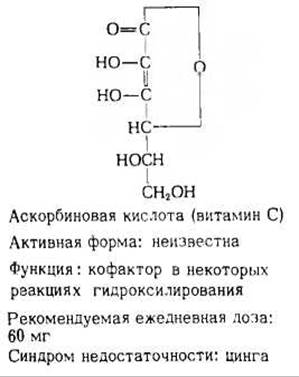
Fig. 26-11. Structure, function, and daily dosage of ascorbic acid.
The recommended daily intake of ascorbic acid for adults in the USA is approximately 60 mg (Fig. 26-11, Table 26-2), which significantly exceeds the minimum physiological requirements. In England, a daily dose of 20 mg is considered sufficient for adults, and as little as 10 mg is enough to prevent scurvy. Citrus fruits, tomatoes, pineapples, cabbage, and green vegetables are the best sources of ascorbic acid, though other fresh fruits and vegetables also contain significant amounts of this vitamin. The bark and leaves of many shrubs are exceptionally rich in ascorbic acid (Supplementary 26-1).
Supplementary 26-1. One of the earliest written accounts of the treatment of scurvy among members of Jacques Cartier's expedition (Newfoundland, 1535)1
“Some of us were losing our last strength... Others, in addition, developed purple Blood spots on their Skin, and their elbows, knees, thighs, shoulders, hands, and necks turned purple. Breath became foul, Gums rotted to such an extent that tooth roots were exposed, after which almost all the Teeth fell out. Our captain, realizing the gravity of the situation, decided to leave the fort and, upon taking the trail, met a group of local inhabitants coming from Stadacona. Among them was Domagaya, who no more than 10–12 days earlier had been gravely ill with the very same disease—his knees were swollen, all his Muscles shriveled, teeth ruined, and gums rotting and foul-smelling. Seeing him alive and well, our captain was overjoyed at the opportunity to learn how he had managed to cure himself in order to help his own men. As soon as they approached each other, the captain immediately asked Domagaya what had helped him recover. Domagaya replied that he had drunk juice from the leaves of a certain tree. Then the captain asked him where this tree grew... Domagaya immediately sent two women, who brought 10 or 12 branches of this tree and demonstrated how to prepare a decoction from its bark and leaves, which should then be drunk every day... In the local language, the tree was called Ameda or Hannedew: it was the sassafras tree (*Sassafras albidum*). The captain immediately had this drink prepared for his men, but no one dared to drink it except for one or two individuals who finally took the plunge. Following their example, the others did the same, and soon everyone began to recover thanks to this beverage. Once the healing Properties of the drink were beyond doubt, such heated disputes broke out over who would drink it first that people seemed ready to kill one another. A tree comparable in size to any oak in France was completely stripped bare within 5 or 6 days, and the healing effect proved so remarkable that if all the physicians of Montpellier or Leuven had appeared here with all the medicines of Alexandria, they would scarcely have achieved in a year what was accomplished by this tree in six days. By the grace of God, all those who took the infusion of the tree's bark and leaves recovered their health.”
1 From Hakluyt’s Principal Navigators, 1600; reprinted from: S. Davidson et al. (eds.), Human Nutrition and Dietetics, 6th ed., Churchill Livingstone, Edinburgh, 1975.
Some nutritionists believe that the body should be fully “saturated” with relatively large doses of ascorbic acid. From their perspective, human physiology genetically adapted to high dietary levels of ascorbic acid back in the era of early hunting and gathering, when most PLANT AND ANIMAL foods were consumed unprocessed. There is also the hypothesis that for optimal health—in particular, to prevent common colds—one should take large daily doses of ascorbic acid, on the order of several grams per day. However, carefully conducted clinical studies have not revealed a statistically significant correlation between high-dose ascorbic acid supplementation and the frequency of colds, although some individuals did experience a clear positive effect. Large doses of ascorbic acid appear to be non-toxic; any excess beyond the body's requirements is excreted either unchanged or as various oxidation products.
Today, of all forms of scurvy, the so-called infantile scurvy is the most common, occurring in infants fed pasteurized or powdered milk without ascorbic acid supplementation. Such infants frequently develop spontaneous subcutaneous hemorrhages and bruise easily upon minor impacts.
Last update: 06/08/2026
Editorial and Educational Adaptation: This material has been compiled based on the primary/original source text. The project team performed an editorial review, corrected technical inaccuracies, structured sections, and adapted the content for an educational format.
What was processed:
- elimination of formatting defects (OCR errors, structural breaks, corrupted characters);
- editorial organization of content;
- standardization of terminology in accordance with academic sources;
- verification of factual statements against the original source text.
All mentions of the author, publication year, and origin of the primary text have been preserved in accordance with the source.