Principles of Biochemistry Volume 3 - A. Lehninger 1985
Molecular Mechanisms of Genetic Information Transfer
DNA Replication and Transcription
Okazaki fragments are joined together by DNA ligase
A new Okazaki fragment is joined to the lagging DNA strand through the action of the enzyme DNA ligase, which catalyzes The formation of a phosphodiester bond between the 3'-hydroxyl group at the end of the DNA strand to be extended and the 5'-phosphate group of the newly synthesized Okazaki fragment. The formation of this bond requires energy, which is supplied by the coupled Hydrolysis of a pyrophosphate bond in NAD+ (in bacterial Cells) or ATP (in animal cells) (Fig. 28-12). The DNA ligase reaction, whose mechanism is quite complex, proceeds most efficiently when the two fragments to be joined are fully complementary to the DNA template strand.
Class="center">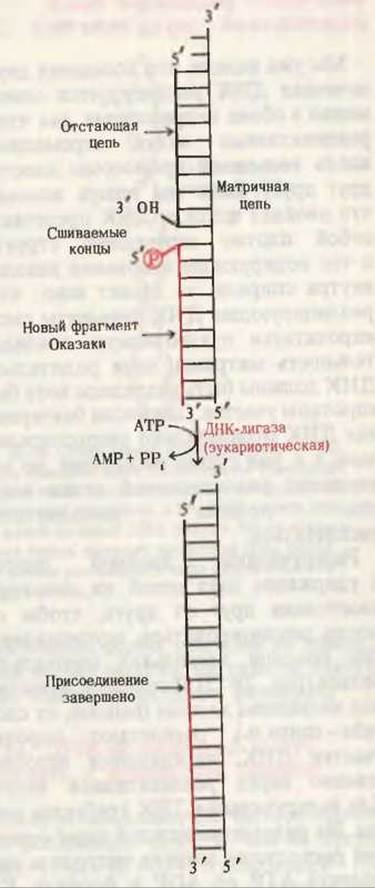
Fig. 28-12. Joining of an Okazaki fragment to the lagging strand, catalyzed by DNA ligase. The two NUCLEOTIDES to be joined must be complementary to the template strand. In fact, the reaction proceeds in several steps.
As we will see below (Chap. 30), DNA ligase also performs other Functions related to the joining of fragments.
Last update: 06/08/2026
Editorial and Educational Adaptation: This material has been compiled based on the primary/original source text. The project team performed an editorial review, corrected technical inaccuracies, structured sections, and adapted the content for an educational format.
What was processed:
- elimination of formatting defects (OCR errors, structural breaks, corrupted characters);
- editorial organization of content;
- standardization of terminology in accordance with academic sources;
- verification of factual statements against the original source text.
All mentions of the author, publication year, and origin of the primary text have been preserved in accordance with the source.