Principles of Biochemistry, Volume 2 - A. Lehninger 1985
Bioenergetics and Metabolism
Biosynthesis of Carbohydrates in Animal Tissues
Gluconeogenesis requires a significant energy input
Table 20-1 lists the reactions leading from Pyruvate to Blood glucose. The overall reaction is as follows:
Class="center">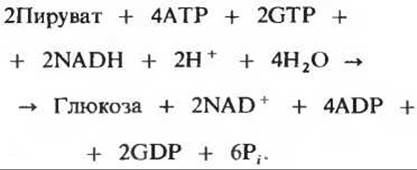
Table 20-1. Sequential reactions of Gluconeogenesis leading from pyruvate to glucose1)
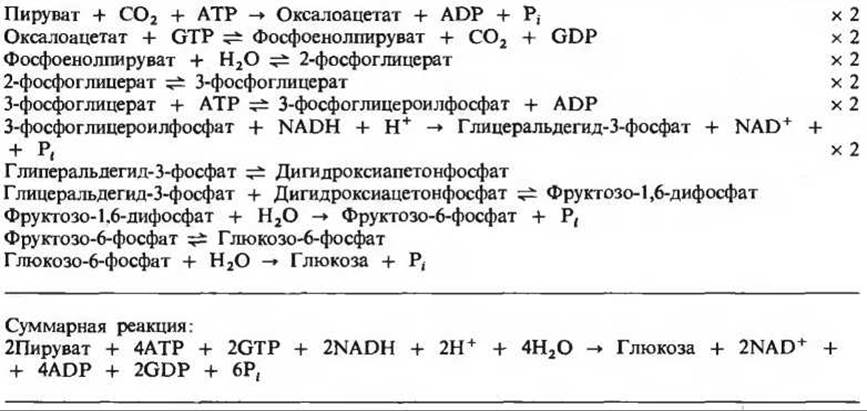
1) Bypass reactions are highlighted in red; all other reactions represent the Reversal of the corresponding steps in The Glycolytic Pathway. The numbers on the right indicate that a given reaction must occur twice because The formation of a single glucose molecule requires two three-carbon precursors.
For each molecule of glucose synthesized from pyruvate, six high-energy phosphate groups are consumed—four from ATP and two from GTP. In addition, two molecules of NADH are required for the reductive steps. Clearly, this equation is not a simple reversal of the equation describing The conversion of glucose to pyruvate during Glycolysis, since that conversion yields a net total of only two molecules of ATP.
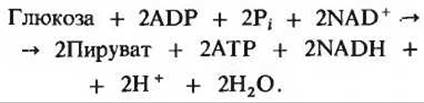
Thus, the Synthesis of glucose from pyruvate is quite costly for the Organism. However, a significant portion of this metabolic cost serves merely to ensure the irreversibility of gluconeogenesis. Under intracellular conditions where the value of ∆GP for ATP can reach 16 kcal/mol (Section 14.10), the overall standard free-energy change for glycolysis is at least —15 kcal/mol. Under the same conditions, the overall free-energy change for gluconeogenesis (the synthesis of glucose from pyruvate) is substantially greater in magnitude. Consequently, under normal intracellular conditions, both glycolysis and gluconeogenesis proceed as essentially irreversible processes.
Last update: 06/08/2026
Editorial and Educational Adaptation: This material has been compiled based on the primary/original source text. The project team performed an editorial review, corrected technical inaccuracies, structured sections, and adapted the content for an educational format.
What was processed:
- elimination of formatting defects (OCR errors, structural breaks, corrupted characters);
- editorial organization of content;
- standardization of terminology in accordance with academic sources;
- verification of factual statements against the original source text.
All mentions of the author, publication year, and origin of the primary text have been preserved in accordance with the source.