Principles of Biochemistry, Volume 1 - A. Lehninger 1985
Biomolecules
Lipids and Membranes
Phospholipids: The Major Lipid Components of Membranes
There are several classes of Membrane Lipids. They differ from triacylglycerols in that, alongside hydrocarbon chains, they contain one or more strongly polar "heads." For this reason, membrane lipids are often referred to as polar lipids. Phospholipids are the most abundant lipids in membranes. They serve as Structural components of membranes and are never stored in large quantities. As the name implies, lipids of this group contain phosphorus (in the form of phosphoric acid residues). Phosphoglycerides (Fig. 12-8) play The Role of the primary phospholipid component of membranes; they contain two fatty acid residues esterifying the First and Second hydroxyl groups of glycerol. The third hydroxyl group of glycerol forms an ester bond with phosphoric acid. In addition, phosphoglycerides contain the residue of another alcohol linked via an ester bond to the phosphoric acid. This second residue is thus localized in the polar HEAD of the phosphoglyceride molecule. Depending on which alcohol is incorporated into the polar head, several classes of phosphoglycerides are distinguished. All phosphoglyceride molecules have two nonpolar tails of long-chain Fatty acids, most commonly 16 or 18 carbon atoms in length. Typically, one of the fatty acids is saturated and the other is unsaturated; the latter always forms an ester bond with the middle hydroxyl group of glycerol, i.e., at C2. Notably, the second carbon atom (C2) of glycerol in a phosphoglyceride molecule is asymmetric and has the L-configuration, since glycerol is derived from L-glyceraldehyde.
Class="center">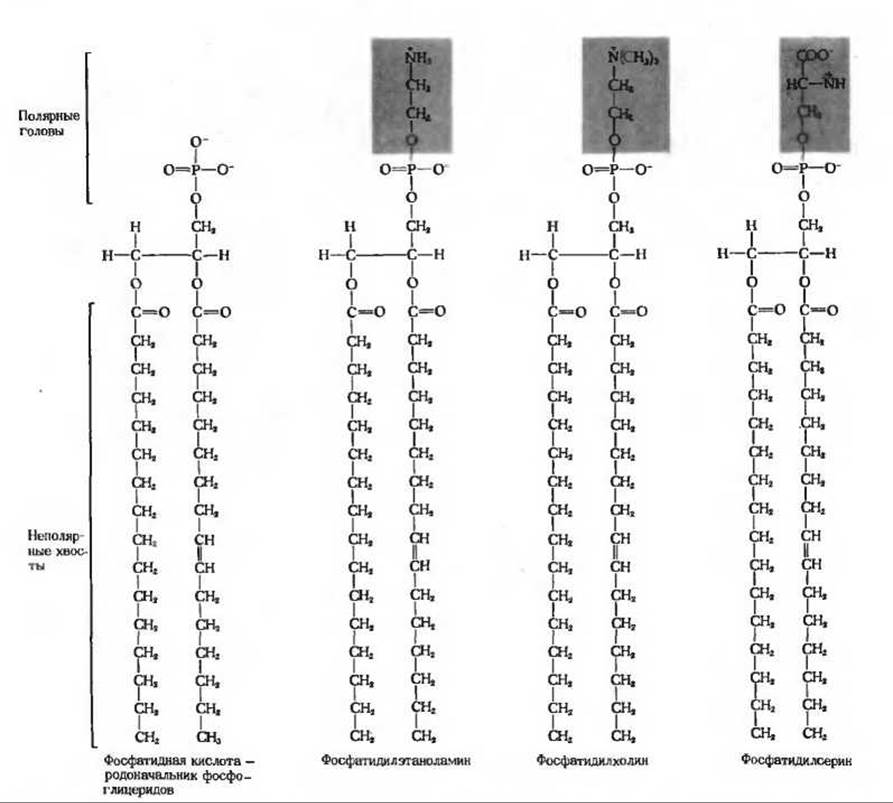
Fig. 12-8. Major phosphoglycerides. The polar heads of phosphoglycerides consist of a negatively charged (at pH 7.0) phosphate group esterified to an alcohol (highlighted in color). The alcohol residue may also carry an electrical charge.
The names of various types of phosphoglycerides are derived from the name of the alcohol present in their polar group (Fig. 12-8). The parent compound for all phosphoglycerides is phosphatidic acid, the head of which lacks an alcohol. It occurs in a free state in very small amounts, serving as an intermediate in the Biosynthesis OF PHOSPHOGLYCERIDES. The most common phosphoglycerides are the structurally similar phosphatidylethanolamine and phosphatidylcholine, whose polar heads contain the alcohols ethanolamine and Choline, respectively. The combinations of fatty acids in the nonpolar portion of these compounds can vary. Phosphoglycerides also include phosphatidylserine, whose polar group contains the residue of the hydroxy amino acid Serine (Sec. 5.7), and phosphatidylinositol, which incorporates the cyclic alcohol Inositol. Cardiolipin, located predominantly in The inner mitochondrial membrane, is unusual in that it is a "double" phosphoglyceride, unlike other phosphoglycerides (Fig. 12-9).
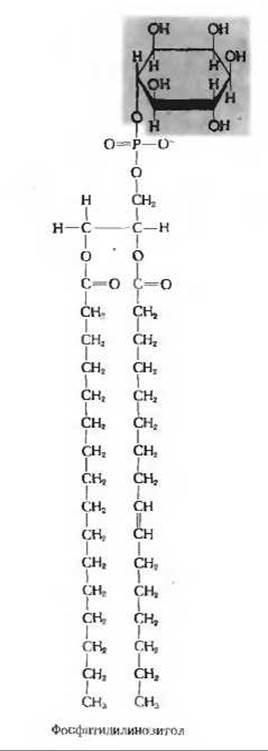
At pH 7.0, the phosphoric acid residue in all phosphoglycerides is negatively charged. Furthermore, at pH values close to 7.0, the alcohol groups of the heads may also carry one or more electrical charges (Fig. 12-8). Thus, phosphoglycerides contain two distinct types of groups, namely polar hydrophilic heads and nonpolar hydrophobic tails. Consequently, phosphoglycerides exhibit amphipathic properties (Sec. 4.3). As a rule, membrane lipids possess amphipathic properties, whereas storage lipids (triacylglycerols and Waxes) lack such properties.
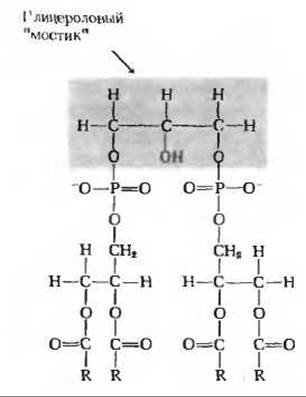
Fig. 12-9. Cardiolipin ("double" phosphoglyceride) is found in large amounts in mitochondrial and bacterial membranes. The letter R denotes long-chain fatty acid hydrocarbon chains.
Upon heating with acids or bases, phosphoglycerides undergo Hydrolysis, breaking down into their basic structural components: fatty acids, glycerol, phosphoric acid, and the polar head alcohol. They can also be hydrolyzed enzymatically by the action of various phospholipases, which catalyze the hydrolytic Cleavage of specific bonds within the phosphoglyceride molecule.
Last update: 06/08/2026
Editorial and Educational Adaptation: This material has been compiled based on the primary/original source text. The project team performed an editorial review, corrected technical inaccuracies, structured sections, and adapted the content for an educational format.
What was processed:
- elimination of formatting defects (OCR errors, structural breaks, corrupted characters);
- editorial organization of content;
- standardization of terminology in accordance with academic sources;
- verification of factual statements against the original source text.
All mentions of the author, publication year, and origin of the primary text have been preserved in accordance with the source.