Vertebrate Zoology - V. M. Konstantinov 2011
Chordates
Gnathostomes
Class Bony Fishes - Subclass Ray-finned Fishes - Superorder Teleost Fishes - Order Salmoniformes
The order Salmoniformes comprises about 400 species of medium- to large-sized fish. They are characterized by a soft, fleshy fold of Skin on the back, known as the adipose fin. Representatives of this group are distributed mainly in temperate and northern latitudes. In addition to strictly freshwater species, many salmonids are anadromous, meaning they grow and mature in the sea and ascend rivers to spawn. The seas of the Far East are particularly rich in salmonids. These waters are inhabited by chum salmon (Oncorhynchus keta), pink salmon (O. gorbuscha), sockeye salmon (O. nerka), and others. These fish spawn in the upper reaches of rivers, while the sockeye salmon also enters lakes. Small fish such as smelts (including the freshwater smelt) also belong to the salmon family.
Class="center">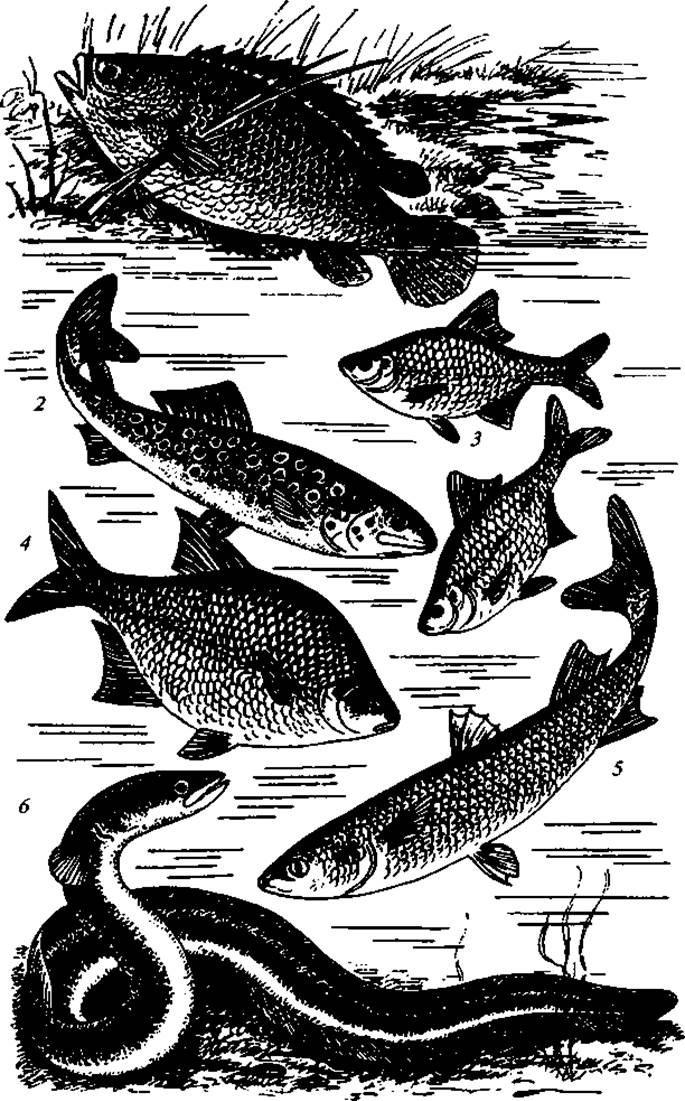
Fig. 41. Bony Fishes:
1 — climbing perch; 2 — trout; 3 — roach; 4 — bream; 5 — mullet; 6 — eel
Among true salmon, mention should be made of the Atlantic salmon (Salmo salar), distributed in the seas of the North Atlantic, the Barents Sea, and the White Sea. It enters the rivers of northern European Russia to spawn. Spawning Migrations occur in summer and autumn. The brown trout (S. trutta), a close relative of the Atlantic salmon, inhabits northern seas as well as the Black and Caspian seas. It breeds in rivers, but does not undertake long feeding migrations into the open sea, and some individuals mature entirely within rivers. A dwarfed resident form of the brown trout has evolved in rivers—the trout (S. trutta morpha fario) (Fig. 41), which inhabits rivers as well as certain mountain lakes. The salmon family also includes strictly resident freshwater species, such as whitefishes, certain omuls, and taimens.
Salmonids are of major commercial importance. Both their flesh and roe are utilized for human consumption.
The low reproductive efficiency of salmonids, combined with their high economic value, has led to the widespread Structure/175.html">Implementation of artificial propagation and stock enhancement programs (see below).
Last update: 13/08/2026
Editorial and Educational Adaptation: This material has been compiled based on the primary/original source text. The project team performed an editorial review, corrected technical inaccuracies, structured sections, and adapted the content for an educational format.
What was processed:
- elimination of formatting defects (OCR errors, structural breaks, corrupted characters);
- editorial organization of content;
- standardization of terminology in accordance with academic sources;
- verification of factual statements against the original source text.
All mentions of the author, publication year, and origin of the primary text have been preserved in accordance with the source.