IMMUNOLOGY TEXTBOOK - Mercury Podillia 2013
IMMUNOLOGICAL RESEARCH METHODS
In vitro diagnostics (detection of IgE antibodies) of specific allergy
Class="center">Table 22. Clinical course of the disease and sensitization features that complicate the identification of causative allergens
No. |
Sensitization features |
Clinical Features of the disease course |
1 |
Pronounced polysensitization of the patient (to many allergens from various groups) |
Severe disease course with persistent symptoms |
2 |
Varying degrees of sensitization to existing allergens |
Relatively minor, infrequent exacerbations of the disease |
3 |
Contact with or exposure to allergens with low or moderate sensitization levels |
Unusual manifestations of allergic disease, etc. |
4 |
Large number of allergens |
Exacerbations or remissions of the disease associated with other mechanisms of allergopathology development or clinically similar manifestations of other conditions |
5 |
Involvement of various mechanisms of allergopathology development in the Pathogenesis of the disease (autoimmune, IgG-dependent, etc.) |
|
6 |
Cross-reactivity to various allergens, including unrelated groups |
These include both the clinical Features of the disease course and the varying degree of patient sensitization to individual allergens (different concentrations of specific IgE). The uncertainty of the relationship between the clinical picture of the disease and the consumption of or contact with allergens is also compounded by the number of allergens to which the patient is sensitized, cross-reactivity to individual allergen Antigens, the presence and significance of other mechanisms driving allergy exacerbations, concomitant diseases, pseudo-allergic reactions, etc.
Some countries around the world manufacture test systems for the determination of specific IgE (Table 23, Fig. 7).
Table 23. Countries where test systems for specific IgE determination are produced
Company Name |
Country |
Phadia AD |
Sweden |
Fooke Laboratorien GMBH |
Germany |
R-Biopharm |
Germany |
Qiagen GMBH |
Germany |
HAL ALLERGY GMBH |
Netherlands-Germany |
Hitachi Chemical Diagnostics inc. (Lumineri distributor) |
USA |
CARLA SYSTEM (Radim) |
Italy |
ADALTIS S.p.A. |
Italy |
SPC IMMUNOTEX LLC |
Russia |
This is due to the fact that ensuring proper diagnostics of causative allergens requires high analytical sensitivity at the sub-nanogram level. It should be noted that imported test systems are characterized by a very high cost (the prime cost of test systems ranges from 3 to 4 euros per assay and higher, while for the patient this analysis costs within 6-8 euros). In addition, the panel of allergens for diagnostics in imported test systems does not include A number of food products, household allergens, etc., that are common in Ukraine.
It should be noted that until now, test systems for specific allergy diagnostics have not been manufactured in Ukraine. Today, diagnostic kits for the determination of specific IgE antibodies produced by Ukrmed-Don LLC (Donetsk), developed at the Donetsk National Medical University, comply with all international standards. Allergens are produced in accordance with developed technological instructions and using state-of-the-art high-tech equipment. Unified quality control Methods are applied to both each semi-finished product and the finished form. The cost of testing using domestic test systems is 6-10 times lower compared to imported analogues.
The evaluation of obtained results for specific IgE antibodies in adults is best performed using the international standard scale, which includes six classes of sensitization degree. The assessment of specific IgE antibody results in children under 10 years of age has certain peculiarities identified during research. The established regularities of normal specific IgE antibody levels are presented in the table below as a scale of sensitization levels according to age (Table 24).
Table 24. Scale of sensitization degrees for individuals of different ages based on specific IgE antibody concentrations
Specific IgE level |
up to 2 years |
2-5 years |
2-5 years |
Adults |
Undetectable |
<0,25 MQ/ml |
<0,20 MQ/ml |
<0,15 MQ/ml |
<0,35 MQ/ml |
Low |
0,26-0,40 MQ/ml |
0,21-0,32 MQ/ml |
0,16-0,24 MQ/ml |
0,36-0,70 MQ/ml |
Moderate |
0,41-1,50 MQ/ml |
0,33-1,20 MQ/ml |
0,25-0,90 MQ/ml |
0,71-3,50 MQ/ml |
High |
1,51-10,00 MQ/ml |
1,21-8,00 MQ/ml |
0,91-6,00 MQ/ml |
3,51-17,50 MQ/ml |
Very high |
10,01-25,00 MQ/ml |
8,01-20,00 MQ/ml |
6,01-15,00 MQ/ml |
17,51-50,00 MQ/ml |
Extremely high |
>25,0 MQ/ml |
>20,0 MQ/ml |
>15,0 MQ/ml |
>50,0 MQ/ml |
A comparison of the test systems developed by specialists of the M. Gorky Donetsk National Medical University with kits from the leading global manufacturer, Phadia AD (Sweden), demonstrated high sensitivity in detecting diagnostically significant specific IgE for low and moderate allergy classes, which in some cases were not detected using test systems from other countries. A high degree of identity in the results obtained using the aforementioned test systems should be noted (Fig. 7).
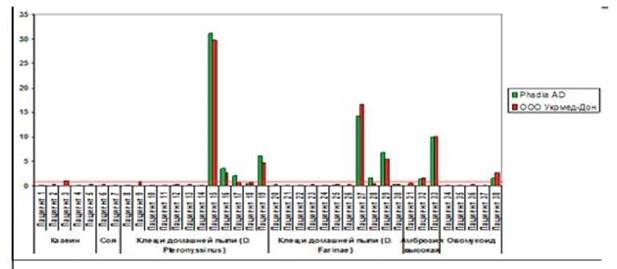
Fig. 7. Comparison of test results obtained using Phadia AD (Sweden) test systems and ELISA test systems by Ukrmed-Don LLC (Ukraine)
The developed domestic test systems belong to the 4th generation and feature high sensitivity and Specificity. They allow tailoring an individual panel of required food, household, pollen, microbial allergens, etc., for testing.
The design of the test systems, as well as the packaging material requirements, comply with international standards. Reagents included in the kits are packaged in vials and ampoules equipped with airtight caps, eliminating the risk of injury to laboratory personnel during handling. The sorbed microplate is stripped and placed in vacuum packaging with an inert gas to prevent quality loss during storage.
These test systems allow the detection of specific IgE antibodies to chicken egg, cow's milk, and other food products ranging from 0.1 to 100 IU/ml. Standards in the range of 0.35-100 IU/ml are utilized.
It should be particularly emphasized that systems have been developed for a unique list of allergens for which sensitization can be detected (Table 25). Of significant importance is The Development of test systems that determine the degree of sensitization to various varieties of apples, peaches, grapes, allergen complexes, etc.
A number of products common in Ukraine that are absent in imported panels have been included (cottage cheese, kefir, pollock, boiled cabbage, fructose, sucrose, and others). It should be noted that individual testing is possible using allergens provided by the patient.
Experience shows that developing an individual diet and anti-allergic measures involving the avoidance or restriction of consumption of and contact with causative allergens provides a significant therapeutic and preventive effect and, in most cases, helps stop relapses of allergic diseases or reduces their severity.
Table 25. List of allergens for which IgE antibodies are determined by test systems of Ukrmed-Don LLC (Donetsk)

Last update: 13/08/2026
Editorial and Educational Adaptation: This material has been compiled based on the primary/original source text. The project team performed an editorial review, corrected technical inaccuracies, structured sections, and adapted the content for an educational format.
What was processed:
- elimination of formatting defects (OCR errors, structural breaks, corrupted characters);
- editorial organization of content;
- standardization of terminology in accordance with academic sources;
- verification of factual statements against the original source text.
All mentions of the author, publication year, and origin of the primary text have been preserved in accordance with the source.