GENERAL MICROBIOLOGY - T.P. Pyrog - 2004
14. TYPES OF FERMENTATION
14.4. PROPIONIC ACID FERMENTATION AND PROPIONIC ACID BACTERIA
14.4.2. Formation of propionic acid
The reduction of lactate or Pyruvate to propionic acid proceeds via the methylmalonyl-CoA pathway (Fig. 14.4).
Class="center">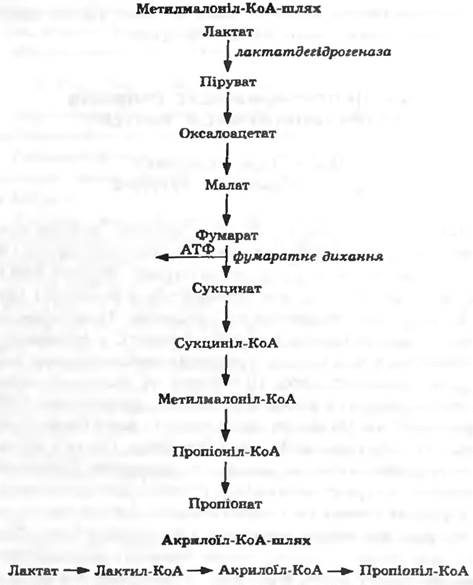
Fig. 14.4. Propionic Acid Fermentation
Initially, pyruvate is converted into oxaloacetate, which is reduced via malate and fumarate to succinate. Electron transport in this segment is coupled with phosphorylation (fumarate Respiration). Subsequently, succinate is transformed into succinyl-CoA and methylmalonyl-CoA, the decarboxylation of which yields propionyl-CoA.
This is the pathway by which propionate is formed in most propionic acid Bacteria, as well as in Veillonella alcalescens and Selenomonas ruminantium.
Propionyl-CoA can also be formed via the acrylyl-CoA pathway (see Fig. 14.4). The intermediate in this process is an acrylic acid derivative, acrylyl-CoA. This is how propionate formation occurs in Clostridium propionicum, Bacteroides ruminicola, and Megasphaera elsdenii.
Last update: 12/08/2026
Editorial and Educational Adaptation: This material has been compiled based on the primary/original source text. The project team performed an editorial review, corrected technical inaccuracies, structured sections, and adapted the content for an educational format.
What was processed:
- elimination of formatting defects (OCR errors, structural breaks, corrupted characters);
- editorial organization of content;
- standardization of terminology in accordance with academic sources;
- verification of factual statements against the original source text.
All mentions of the author, publication year, and origin of the primary text have been preserved in accordance with the source.