Orthopedics - Oleksa A.P. 2006
Spinal Disorders Causing Pain
Spondylosis and Spondyloarthritis
Under METABOLISM/18.html">The Influence of chronic overload, injuries, various biomechanical factors, and involutional Changes in the body, a specific spinal deformity develops — spondylosis.
The Essence of the pathology lies in degenerative-dystrophic and compensatory-productive processes within the spine, particularly in its thoracic and lumbar regions. Degenerated discs, the ligamentous apparatus, and osteoporotic vertebral bodies gradually settle under applied loads: intervertebral spaces narrow, and the vertebral bodies acquire a wedge-like shape. A spinal deformity resembling a hunched posture emerges — an increased Kyphosis. The disruption of the spinal axis leads to uneven loading across its various segments, triggering compensatory marginal proliferations of fibrous Tissues that stabilize the spine, undergo ossification, and present on radiographs with the characteristic appearance of "marginal osteophytes" (Fig. 300). This represents a peculiar form of sanogenesis by the body, as it increases the surface area for intervertebral load distribution and "props up the spine" on the concave side, ultimately resulting in complete ossification and intervertebral synostosis. When the articular processes are secondarily involved in the process, spondylarthrosis of the respective spinal region develops. This, in turn, leads to the narrowing of intervertebral foramina, compression of nerve roots accompanied by corresponding neurological symptoms, depending on the localization and number of affected vertebrae. Diagnosing spondylosis is straightforward: initially, sensations of stiffness, restricted spinal mobility, and an increase in physiological kyphosis appear, after which the spine becomes fixed, followed by pain and other radicular disorders. In all cases, the Diagnosis is confirmed radiologically (via plain radiography or tomography).
Class="center">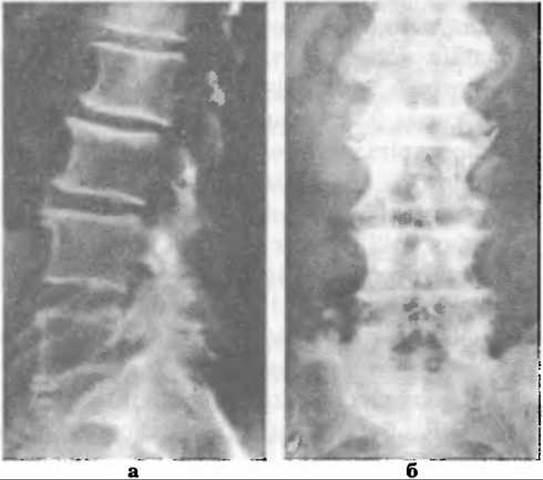
Fig. 300. Spondylosis in a 65-year-old patient (a), spondylarthrosis in a 76-year-old patient (b).
The Treatment of spondylosis is conservative: traction, therapeutic exercise (kinesiotherapy), load relief, physiobalneotherapy, and sanatorium-resort treatment. When necessary, analgesics, novocaine blockades, orthoses, and other measures are prescribed.
Last update: 10/08/2026
Editorial and Educational Adaptation: This material has been compiled based on the primary/original source text. The project team performed an editorial review, corrected technical inaccuracies, structured sections, and adapted the content for an educational format.
What was processed:
- elimination of formatting defects (OCR errors, structural breaks, corrupted characters);
- editorial organization of content;
- standardization of terminology in accordance with academic sources;
- verification of factual statements against the original source text.
All mentions of the author, publication year, and origin of the primary text have been preserved in accordance with the source.