MEDICAL BOTANY - A.G. Serbin - 2003
SECTION 3. SYSTEMATICS
SUPERKINGDOM EUKARYOTA (NUCLEATED) — EUCARYOTA. KINGDOM PLANTAE
SPORE PLANTS
PHYLUM LYCOPHYTA — LYCOPHYTA (LYCOPODIOPHYTA)
Class Isoetopsida — Isoetopsida
Family Selaginellaceae — Selaginellaceae
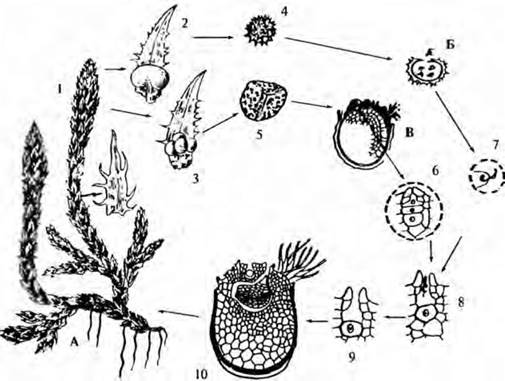
Selaginella selaginoides (Lesser Clubmoss) — Selaginella selaginoides (Fig. 3.103). It grows in both hemispheres on damp rocks and along riverbanks. A perennial herbaceous heterosporous plant, 5 — 10 cm in length. Shoots are creeping and branched; the stem is round. Leaves are thin, reflexed, oblong-ovate, pointed, and dentate. At their base on the upper side, There is a ligule. Sporiferous spikes, or strobili, are terminal, solitary, oval-cylindrical, and about 3 cm long. Sporophylls are longer than vegetative leaves (about 5 mm), featuring numerous long Teeth and ligules. The upper part of the strobilus contains smaller microsporophylls with a microsporangium at the base. These contain numerous microspores, inside of which male microgametophytes, or prothallia, develop with spermatozoa. The lower part of the strobilus houses megasporophylls with macro- or megasporangia. They contain 4 large megaspores each, within which female megagametophytes, or prothallia, germinate. Thus, the prothallia are dioecious. The female prothallium bears a small, protruding lobe that carries archegonia with an egg Cell. Following Fertilization, an embryo of a new sporophyte develops from the zygote (Fig. 3.103).
Class="center">Fig. 3.103. Life Cycle of heterosporous clubmosses using *Selaginella selaginoides* as an example: A — sporophyte; B — male prothallium — microgametophyte; C — female prothallium — megagametophyte; 1 — strobilus; 2 — microsporophyll with microsporangium; 3 — megasporophyll with megasporangium; 4 — microspore; 5 — megaspore; 6 — archegonium; 7 — sperm cell; 8 — fertilization; 9 — zygote; 10 — development of a new sporophyte
Last update: 07/08/2026
Editorial and Educational Adaptation: This material has been compiled based on the primary/original source text. The project team performed an editorial review, corrected technical inaccuracies, structured sections, and adapted the content for an educational format.
What was processed:
- elimination of formatting defects (OCR errors, structural breaks, corrupted characters);
- editorial organization of content;
- standardization of terminology in accordance with academic sources;
- verification of factual statements against the original source text.
All mentions of the author, publication year, and origin of the primary text have been preserved in accordance with the source.