Protein Structure and Function. Application of Bioinformatics Methods - John Rigden 2014
Prediction of Membrane Protein Structure
Prediction of Transmembrane Protein Topology
Alpha-Helical Proteins
As noted earlier, TM Proteins are vastly underrepresented in structural Databases, which significantly hampers their study. At the same time, TM proteins are of great biological and pharmacological importance; therefore, understanding their topology—the total number of TM helices, their boundaries, and their orientation relative to the membrane—is a top priority for theoretical prediction. There are experimental Methods, such as glycosylation analysis, mutagenesis via insertions, antibody studies, and fusion protein assays, that can determine the localization of individual regions within the topology. However, these studies are time-consuming, their results are often conflicting (Mao et al. 2003; Kyttala et al. 2004), and there is also the risk of disrupting the native topology due to sequence modifications.
In the absence of structural data, modern bioinformatics strategies rely primarily on sequence-based prediction methods. Long before the advent of the first crystallographic structures, it became possible to identify TM helices as sequence segments composed of hydrophobic residues that are sufficiently long to span Cell/29.html">The Lipid Bilayer. Early prediction methods by Kyte and Doolittle (1982) and Engelman et al. (1986), and later by Wimley and White (1996), were based on experimentally derived Structure/106.html">Hydrophobicity scales used to generate hydrophobicity plots for the protein of interest. The Procedure involved a moving-average smoothing technique with a window size of 19–21 residues, averaging the data to form peaks on the plot (regions of high hydrophobicity) corresponding to TM helices (Fig. 4.3).
As the number of analyzed sequences grew, it was discovered that aromatic residues Trp and Tyr tend to cluster near the ends of transmembrane segments (Wallin et al. 1997). These clusters likely act as physical anchors that stabilize TM helices within the lipid bilayer. Later studies revealed specific Sequence Motifs within transmembrane helices, such as the GxxxG motif (Senes et al. 2000), as well as periodic elements involved in helix packing and The formation of the Three-Dimensional Protein Structure (Samatey et al. 1995). However, one of The most significant breakthroughs during this period was the discovery that positively charged residues tend to be located in cytoplasmic loops—a pattern known as the "positive-inside rule" formulated by von Heijne (von Heijne 1992). All of these insights, combined with hydrophobicity-based predictions, led to The Development of early topology prediction tools such as TopPred (Claros and von Heijne 1994).
Class="center">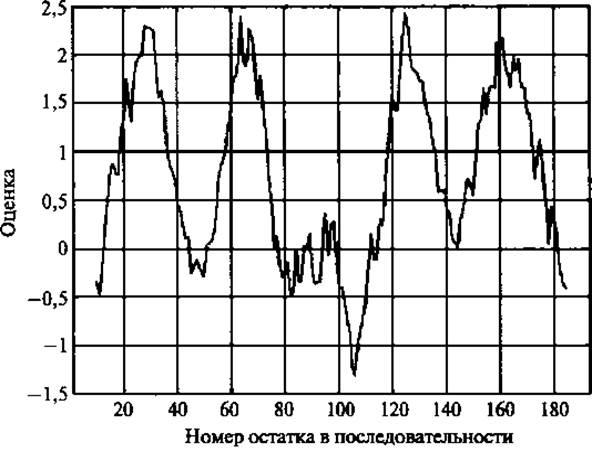
Fig. 4.3. Kyte-Doolittle hydrophobicity plot. The protein sequence was analyzed using a moving-average method with a window size of 19–21 residues. For each position, the average amino acid hydrophobicity index within the window is calculated, and the resulting value is plotted at the center of the window. The graph shown corresponds to a TM protein with 4 TM helices.
4.6.1.1. Machine Learning-Based Approaches
Despite their initial success, early Methods based on the physicochemical sliding-window principle of hydrophobicity and the "positive-inside rule" were eventually superseded by machine learning-based approaches. The advantage of the latter lies in their probabilistic framework. Several machine learning-based prediction methods are listed in Table 4.3.
Table 4.3. Machine learning-based methods for transmembrane alpha-helix topology prediction
Method |
URL |
Algorithm |
Features |
MEMSAT3 |
http://bioinf.cs.ucl.ac.uk/psipred/ |
Neural networks |
Signal Peptides, MSA*, GpA** |
MINNOU |
http://minnou.cchmc.org/ |
Neural networks |
MSA |
PHDhtm |
http://www.predictprotein.org/ |
Neural networks |
Signal peptides, MSA, constrained |
Phobius |
http://phobius.sbc.su.se/ |
GpA |
|
TMHMM |
http://www.cbs.dtu.dk/services/TMHMM/ |
Hidden Markov models |
Re-entrant loops, GpA |
PRODIV-TMHMM |
http://www.pdc.kth.se/~hakanv/prodiv-tmhmm/ |
Hidden Markov models |
Constrained |
HMMTOP |
http://www.enzim.hu/hmmtop/ |
Hidden Markov models |
MSA |
ENSEMBLE |
http://pongo.biocomp.unibo.it/pongo/ |
Neural networks and hidden Markov models |
Membrane loops |
OCTOPUS |
http://octopus.cbr.su.se/ |
Neural networks and hidden Markov models |
Consensus |
SVMtop |
http://biocluster.iis.sinica.edu.tw/~bioapp/SVMtop/ |
Support vector machines |
Consensus |
PONGO |
http://pongo.biocomp.unibo.it/pongo/ |
Meta-predictor |
|
BPROMPT |
http://www.jenner.ac.uk/bprompt/ |
Meta-predictor |
* - Topology prediction is performed using Multiple Sequence Alignments (MSA).
** - Method suitable for whole-Genome Analysis (GpA).
Among the first attempts to apply hidden Markov models (HMMs) to transmembrane topology prediction were TMHMM (Krogh et al. 2001) and HMMTOP (Tusnady and Simon 1998), both of which proved to be highly successful. TMHMM employs a cyclic model with seven transmembrane helix states, whereas HMMTOP uses hidden Markov models to recognize one of five structural states (helix core, inside loop, outside loop, helix termini (C and N), and globular domains). These states are interconnected via transition probabilities. Dynamic programming is then used to search for the model with the most probable topology for a given sequence. HMMTOP also allows for the incorporation of experimental constraints—fixing specific residues to particular topological regions—to yield constrained topology predictions.
Artificial neural networks (ANNs) are utilized in methods such as PHDhtm (Rost et al. 1996) and MEMSAT3 (Jones 2007). PHDhtm performs multiple sequence alignments using a combination of two ANNs for consistent TM helix topology prediction. First, a "sequence-to-structure" network is built to capture the structural predisposition of the central residue within the sliding window. Then, a second "structure-structure" network smooths these predispositions, after which the "positive-inside rule" is applied to generate the overall TM helix topology. MEMSAT3, which combines a neural network with dynamic programming, not only predicts TM helix topology but also evaluates the quality of the predicted topology and identifies potential signal peptides. Additional evolutionary information derived from multiple sequence alignments has increased prediction accuracy to up to 80% for a single dataset (Jones 2007).
More recently, support vector machines (SVMs) have been applied to TM protein topology prediction (Yuan et al. 2004; Lo et al. 2008). Unlike neural networks and hidden Markov models, which can output multiple data sets directly, SVMs function as binary classifiers. To classify diverse residue preferences, the method must be applied iteratively, after which the results can be combined within a probabilistic framework. Although multi-class ranking is technically feasible, it is generally considered unreliable because a single mathematical function that cleanly separates the data into multiple classes often does not exist. Nevertheless, SVMs enable the algorithm to learn complex relationships among Amino Acids within the training window, especially when Introduction/18.html">Protein Evolution data are incorporated. SVMs also offer greater flexibility than other machine learning methods regarding the overfitting problem, although tuning numerous parameters can make the optimization process extremely time-consuming.
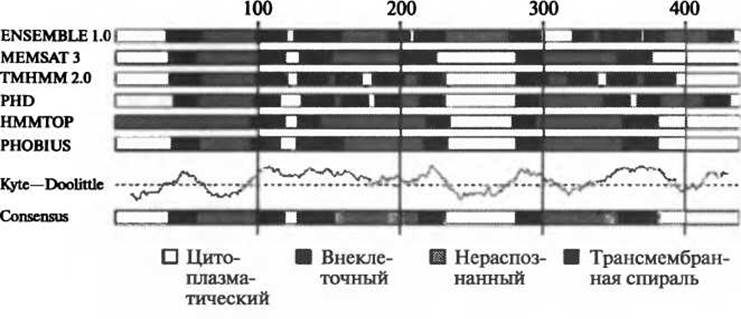
Fig. 4.4. Using multiple methods for consensus topology prediction.
4.6.1.2. Consensus Approaches
Some modern methods combine different machine learning approaches. The ENSEMBLE method (Martelli et al. 2003) utilizes one neural network and two hidden Markov models, whereas OCTOPUS (Viklund and Elofsson 2008) employs two layers consisting of four neural networks and one hidden Markov model. Both methods offer higher prediction accuracy than single-algorithm classifiers. In the BPROMPT method (Taylor et al. 2003), which also takes a consensus approach, the outputs of five different prediction tools are processed using a Bayesian belief network to derive the final topology. Nilsson and co-workers (Nilsson et al. 2002) similarly used five prediction methods, but applied a majority-voting rule to select the final topology. The PONGO server (Amico et al. 2006) outputs the results of five topology prediction methods in a graphical format for direct comparison. In most cases, it is prudent to consider several theoretical models generated by different prediction algorithms (Fig. 4.4), particularly for protein molecules with complex topologies.
4.6.1.3. Signal Peptides and Membrane Helices
One of the challenges facing modern topology prediction methods is distinguishing TM helices from other structural elements that contain a high proportion of hydrophobic residues. These elements include targeting motifs such as signal peptides and signal anchors, amphipathic helices, and membrane-embedded helices—helices that penetrate the membrane but enter and exit on the same side. The latter are characteristic of many ion channel families (Fig. 4.5).

Fig. 4.5. (For the color version of this figure, see the insert.) Potassium channel subunit from Streptomyces lividans containing a membrane-embedded helix (center, top). PDB ID 1r3j.
The hydrophobicity profiles of such protein structures and TM helices share a high degree of similarity, frequently leading to overlapping predictions between different types. If these structural elements are misidentified as TM helices, subsequent topology predictions are likely to be fragmented. Certain prediction tools, such as SignalP (Berendsen et al. 2004) and TargetP (Emanuelsson et al. 2007), are effective at identifying signal peptides and can be used as a preliminary filter prior to TM topology prediction. Phobius (Kall et al. 2004) employs a hidden Markov model to address the signal peptide problem in TM protein topology prediction. In PolyPhobius (Kall et al. 2005), prediction accuracy is enhanced by incorporating Homology information. Other methods, such as TOP-MOD (Viklund et al. 2006) and OCTOPUS, have attempted to integrate the identification of membrane-embedded regions into the TM topology prediction process, though this approach still requires refinement. The main challenge, particularly regarding membrane helices, is the scarcity of reliable training data for machine learning.
Last update: 06/08/2026
Editorial and Educational Adaptation: This material has been compiled based on the primary/original source text. The project team performed an editorial review, corrected technical inaccuracies, structured sections, and adapted the content for an educational format.
What was processed:
- elimination of formatting defects (OCR errors, structural breaks, corrupted characters);
- editorial organization of content;
- standardization of terminology in accordance with academic sources;
- verification of factual statements against the original source text.
All mentions of the author, publication year, and origin of the primary text have been preserved in accordance with the source.