Protein Structure and Function. Application of Bioinformatics Methods - John Rigden 2014
Protein Dynamics: From Structure to Function
Methods for Predicting Functional Modes
Normal Mode Analysis
As discussed in the previous section, the functional modes in Proteins are typically the lowest-frequency ones. Besides Structure/8.html">Molecular Dynamics-based techniques, there are several alternative Methods focused on predicting these essential degrees of freedom based on a single structure.
Normal mode analysis (NMA) is one of the primary computational techniques used to study large-scale Conformational Changes in biological molecules (Go- et al. 1983; Brooks and Karplus 1983; Levitt et al. 1983). These motions are frequently coupled to function and result from the binding of other molecules, such as substrates, drugs, or other proteins. Normal mode analysis implicitly assumes that the highest-amplitude modes (the lowest-frequency modes) are precisely the functionally significant ones because, much like Functions themselves, they owe their existence to evolutionary design rather than chance.
Normal mode analysis is a harmonic analysis. It relies on the assumption that the Conformational Energy surface can be approximated by a parabola, even though functional modes at physiological temperatures are strongly anharmonic (Brooks and Karplus 1983; Austin et al. 1975). Performing normal mode analysis requires a set of coordinates, a force field describing atomic interactions, and a computer program to carry out the required calculations. Performing normal mode analysis in Cartesian coordinates involves three main computational steps.
1. Minimization of the conformational potential energy as a function of atomic coordinates.
2. Calculation of the so-called Hessian matrix
Class="center">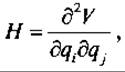
which is the matrix of second derivatives of the potential energy with respect to mass-weighted atomic coordinates2.
3. Diagonalization of the Hessian. This final step yields the eigenvalues and eigenvectors (“normal modes”).
Energy minimization can be quite computationally expensive. Furthermore, since the Hessian is a 3N × 3N matrix, where N is the number of atoms, the final step can also be very demanding in terms of computing resources.
2 The transition to mass-weighted coordinates 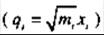 arises from simplifying the Hamiltonian of a system of atoms. Translator's Note.
Last update: 06/08/2026
Editorial and Educational Adaptation: This material has been compiled based on the primary/original source text. The project team performed an editorial review, corrected technical inaccuracies, structured sections, and adapted the content for an educational format.
What was processed:
- elimination of formatting defects (OCR errors, structural breaks, corrupted characters);
- editorial organization of content;
- standardization of terminology in accordance with academic sources;
- verification of factual statements against the original source text.
All mentions of the author, publication year, and origin of the primary text have been preserved in accordance with the source.