BIOCHEMISTRY - L. Stryer - 1984
VOLUME 2
PART II GENERATION AND STORAGE OF METABOLIC ENERGY
CHAPTER 13. THE CITRIC ACID CYCLE
APPENDIX. RS NOTATION OF CHIRALITY
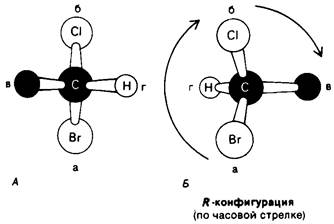
The absolute configuration of any chiral center can be unambiguously assigned using the RS notation system introduced in 1956 by Robert Cahn, Christopher Ingold, and Vladimir Prelog. Let us examine this using the chiral compound CHFCIBr as an example (Fig. 13.17, A). The first step in the RS notation system is to determine the priority sequence of the four substituents, based on the rule that an atom with a higher atomic number has priority over an atom with a lower atomic number. Consequently, the four substituents in our example have the following priority sequence: a-Br, b-Cl, c-F, and d-H, with the highest priority belonging to Br (a). Next (the second step), the molecule is oriented such that the group with the lowest priority (d) points away from the observer. For CHFCIBr, this means orienting the molecule so that H is directed away from us (behind the plane of the page in Fig. 13.17, B). Finally (the third step), one determines whether the path from a to b and then to c proceeds in a clockwise or counterclockwise direction under these conditions. If the path is clockwise (to the right), the configuration is designated as R (from Latin rectus, right); if it is counterclockwise, the configuration is designated as S (from Latin sinister, left). The configuration of the CHFCIBr stereoisomer shown in Fig. 13.17 is the R-configuration.
Class="center">Fig. 13.17. The stereoisomer of CHFCIBr shown here has the R-configuration
Now let us consider the RS notation for Alanine (Fig. 13.18, A). The four atoms bonded to the α-carbon are N, C, C, and H. The priority sequence between the methyl carbon and the carboxyl carbon is determined by moving outward to the next set of atoms. It is helpful to note the priority sequence for groups commonly encountered in biochemistry: —SH (highest priority), —OR, —OH, —NHR, —NH2, —COOR, —COOH, —CHO, —CH2OH, —C6H5, —CH3, —T, —D, —H (lowest priority).
Fig. 13.18. L-alanine has the S-configuration
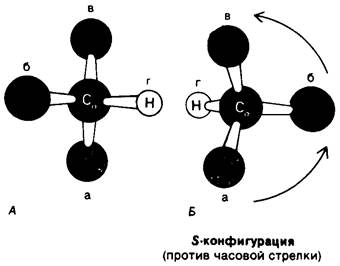
Thus, the priority sequence of the four groups attached to the α-carbon atom of alanine is as follows: a — NH3+, b —COO-, c —CH3, and d —H. The molecule of L-alanine is then oriented so that the lowest-priority group (—H) lies behind the plane of the page (Fig. 13.18, B). The path from a (—NH3+) to b (—COO-) and c (—CH3) then proceeds in a counterclockwise direction (to the left), which indicates that L-alanine has the S-configuration.
Last update: 06/08/2026
Editorial and Educational Adaptation: This material has been compiled based on the primary/original source text. The project team performed an editorial review, corrected technical inaccuracies, structured sections, and adapted the content for an educational format.
What was processed:
- elimination of formatting defects (OCR errors, structural breaks, corrupted characters);
- editorial organization of content;
- standardization of terminology in accordance with academic sources;
- verification of factual statements against the original source text.
All mentions of the author, publication year, and origin of the primary text have been preserved in accordance with the source.