Principles of Protein Structural Organization - G. Schultz 1982
Models, Depiction, and Documentation of Protein Structures
Abstract Concepts of Chain Folding
Distance Maps Between Cα-atoms
Chain folding can be represented by Ca–Ca distance maps. The atomic coordinates of Ca that determine chain folding are completely defined by the distance map between Ca atoms, since all coordinates (except for three) can be easily derived trigonometrically from these distances*. On the mutual Ca distance map, points in certain regions lie extremely close to one another. Therefore, contour lines of equal distances can be used, similar to contours on an electron density map. In this way, chain folding can be represented using a two-dimensional graph.
Class="center">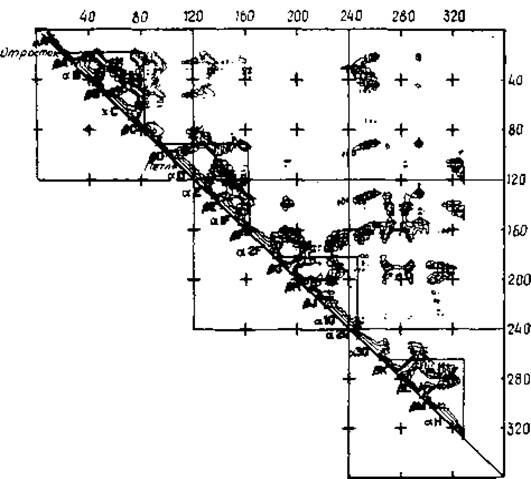
Fig. 7.11. Inter-residue contact map of Lactate dehydrogenase [407]. Distances between the Ca atoms of the i-th and j-th residues are represented as a triangular matrix. The results are presented in contour rather than numerical form; contours are drawn at 16, 12, 8, and 4 Å. Various structural elements are identified relative to the diagonal; the triangles correspond to four geometrically well-defined subdomain structures. Two triangles on the N-terminal side represent ßaßaß units.
Secondary structures are identified by characteristic regions on the distance map. a-Helices correspond to short distances (dense contour lines) along the diagonal, whereas parallel ß-pleated sheets correspond to short distances along lines parallel to the diagonal (Fig. 7.11). For antiparallel ß-pleated sheets, as well as reverse turns, regions of short distances running perpendicular to the diagonal are characteristic [406]. The arrangement of lines on the Ca distance map serves as a unique "fingerprint" of chain folding. Moreover, insertions and deletions only partially disrupt the overall pattern by adding or deleting a matrix row. Therefore, such maps can be used to compare chain folding [407].
* Given N∙(N + 1)/2 distances (i.e., equations) for 3(N — 1) unknown coordinates, the problem can be solved uniquely for three Ca atoms and becomes overdetermined for four or more Ca atoms.
Other dependencies. The plot of nearest-neighbor residue correlations in Fig. 5.14a is also nothing more than a very specific Ca distance plot. However, it cannot be used to retrieve the original coordinates.
Lewis et al. [202] plotted the distance between Cai and Ci+3 as a function of the residue number i. Such a plot makes it possible to identify all polypeptide chain turns (Section 5.1); it also has the advantage of revealing turns that do not conform to the types listed by Venkatachalam [199]. However, in this case as well, it is impossible to reconstruct the original coordinates, since there are only N—3 distances for 3N—3 coordinates.
A plot of radial distances from a given point in the molecule, such as a Trp residue, may be of interest in relevant spectroscopic studies. In such a plot, the chain is unwrapped in a closed circle, and the distances from all Cai atoms to the selected point are plotted radially.
A schematic distance plot showing the list of contacts between atoms of different subunits in an oligomeric protein is presented in Fig. 5.18d.
All Ca distance plots discussed in this section can be easily programmed using Ca coordinates provided, for example, by the Protein Data Bank [390].
Last update: 06/08/2026
Editorial and Educational Adaptation: This material has been compiled based on the primary/original source text. The project team performed an editorial review, corrected technical inaccuracies, structured sections, and adapted the content for an educational format.
What was processed:
- elimination of formatting defects (OCR errors, structural breaks, corrupted characters);
- editorial organization of content;
- standardization of terminology in accordance with academic sources;
- verification of factual statements against the original source text.
All mentions of the author, publication year, and origin of the primary text have been preserved in accordance with the source.