Principles of Protein Structural Organization - H. Schultz 1982
Statistical Mechanics of the Helix-Coil Transition
The Zimm-Bragg Model for the Helix-Coil Transition
Matrix Representation
Matrix formulation of the Distribution Function. Kramers and Wannier [790] suggested writing equation (A.6) in a compact matrix form that simplifies the calculation of Z.
Class="center">
Let us verify that this expression is consistent with equation (A.6) for small N:
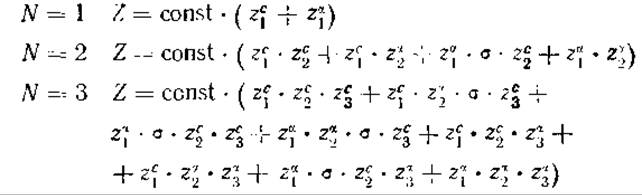
These relations can also be extended to large values of N.
The simple case of a homopolymer is satisfactorily described by an Nth-order matrix in terms of eigenvalues. Applying equation (A.7) to homopolymers makes all quantities zia, as well as zci, identical. To further simplify the expressions, the relative statistical weights s can be expressed as

We can treat (zсі)N as a constant and omit it, since we are interested only in The change in Z during the helix–coil transition rather than its absolute value.

By diagonalizing the matrix, this can be reduced to the expression:

When
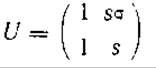
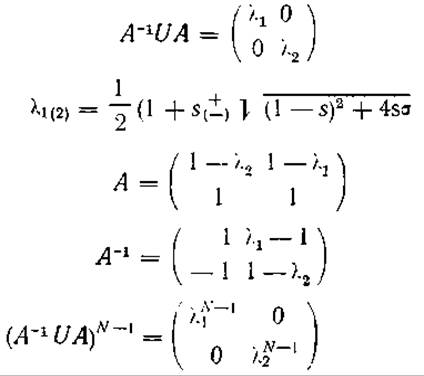
that is, Z can be explicitly expressed as a function of the eigenvalues.

Since λ1 > 1 > λ2 for all s and σ, the partition function for large N can be approximated as

Last update: 06/08/2026
Editorial and Educational Adaptation: This material has been compiled based on the primary/original source text. The project team performed an editorial review, corrected technical inaccuracies, structured sections, and adapted the content for an educational format.
What was processed:
- elimination of formatting defects (OCR errors, structural breaks, corrupted characters);
- editorial organization of content;
- standardization of terminology in accordance with academic sources;
- verification of factual statements against the original source text.
All mentions of the author, publication year, and origin of the primary text have been preserved in accordance with the source.