Principles of Biochemistry, Volume 3 - A. Lehninger 1985
Molecular mechanisms of genetic information transfer
DNA replication and transcription
RNA transcripts undergo further processing
RNA transcripts synthesized by RNA polymerase typically undergo further enzymatic modifications known as post-transcriptional Processing before acquiring full functional activity. rRNA and tRNA are synthesized as longer precursors that are subsequently modified and cleaved to yield the final products. Eukaryotic mRNA transcripts also undergo processing, whereas prokaryotic mRNAs do not.
Class="center">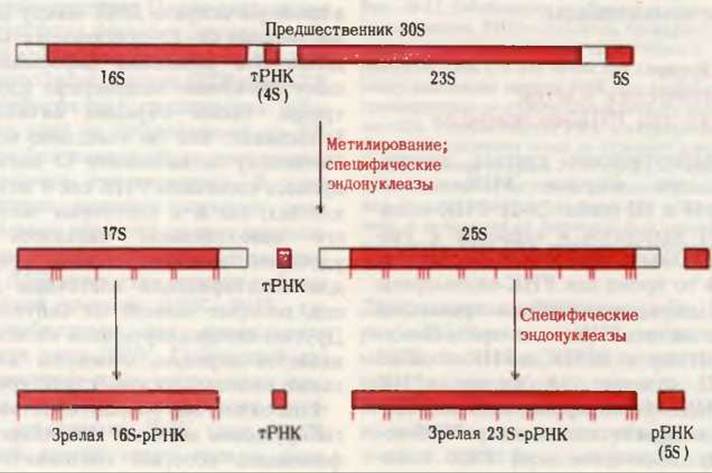
Fig. 28-19. Processing ("maturation") of the rRNA transcript in prokaryotes. Mature 16S and 23S rRNA molecules are generated from a longer 30S RNA precursor through the action of specific Nucleases. Prior to Cleavage, the 30S RNA is methylated at specific bases (indicated by red vertical ticks). A single tRNA molecule is formed from the middle portion of the precursor.
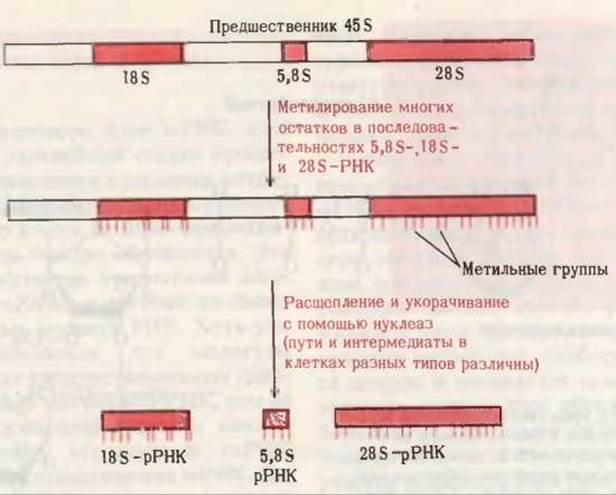
Fig. 28-20. Processing of eukaryotic rRNA transcripts. Methylation, the initial step in processing, occurs at the 2'-hydroxyl groups of ribose residues in Regions of the precursor that are retained in the mature RNAs. 5S rRNA is transcribed separately.
rRNAs in both eukaryotic and Prokaryotic Cells are derived from longer precursor molecules called preribosomal RNAs. In prokaryotes, 16S and 23S rRNAs (Chapter 29) are formed from a single long 30S precursor with a molecular mass of approximately 2∙106. This precursor is methylated at specific bases and cleaved to yield 17S and 25S intermediate RNAs, which are subsequently processed by nuclease trimming to produce the 16S and 23S rRNAs characteristic of prokaryotes (Fig. 28-19). 5S rRNA is synthesized separately from the 3'-terminal region of the 30S precursor.
In eukaryotes, 18S and 28S rRNAs are generated in several steps from a large 45S preribosomal RNA. Processing of the 45S RNA takes place in the nucleolus. First, more than 100 of the 14,000 NUCLEOTIDES in the 45S precursor are methylated, with modifications occurring primarily at the 2'-hydroxyl groups of ribose residues. As shown in Fig. 28-20, the methylated 45S RNA then undergoes a series of enzymatic cleavages that ultimately yield the 18S, 28S, and 5.8S rRNAs characteristic of eukaryotic Ribosomes. Eukaryotic 5S rRNA is synthesized independently.
tRNAs are also synthesized from longer RNA precursors via the enzymatic removal of excess nucleotides from the 5'- and 3'-ends of the molecule. In some cases, Enzymatic cleavage of a single long precursor molecule yields two or even more different tRNAs. As we will see below (Section 29.20), there are at least 32 different tRNAs, and likely many more.
During post-transcriptional processing of tRNA precursors, Two Types of modifications occur alongside the removal of terminal sequences. First, a 3'-terminal trinucleotide sequence —C—C—A (3') is added to certain tRNAs, whereas other tRNAs already contain this 3'-terminal trinucleotide in their transcript. As discussed below, the 3'-terminal A residue is the exact site on the tRNA molecule to which the corresponding amino acid is covalently attached prior to its incorporation into the growing polypeptide chain on the ribosome. Second, A number of bases in tRNAs are modified in a specific manner: some are methylated, others are deaminated, and still others are reduced. As we will see later (Chapter 29), these modified bases occupy conserved positions in all tRNAs.
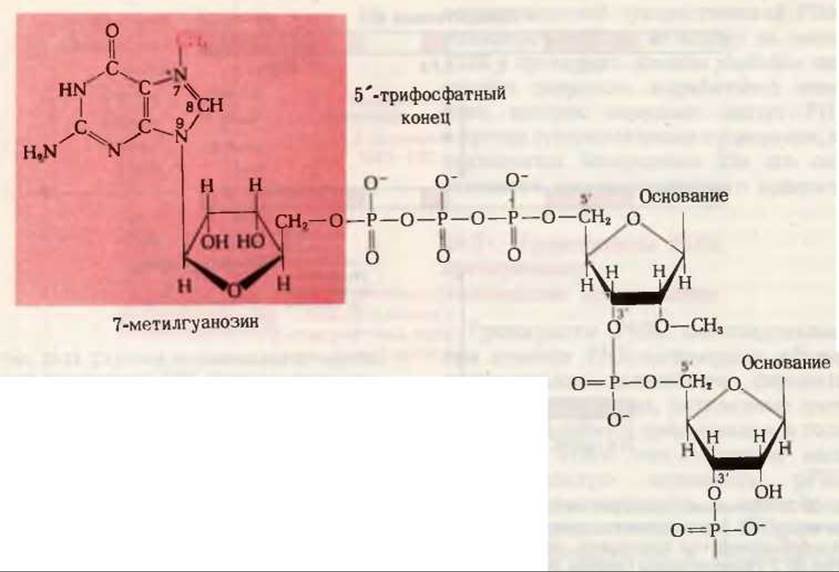
Fig. 28-21. The 5'-cap of a eukaryotic mRNA, consisting of a 7-methylguanosine residue; the methyl group is highlighted in red. Note that the cap is linked to the 5'-terminal nucleotide via a triphosphate bridge. Nearly all eukaryotic mRNAs contain 5'-caps.
Last update: 06/08/2026
Editorial and Educational Adaptation: This material has been compiled based on the primary/original source text. The project team performed an editorial review, corrected technical inaccuracies, structured sections, and adapted the content for an educational format.
What was processed:
- elimination of formatting defects (OCR errors, structural breaks, corrupted characters);
- editorial organization of content;
- standardization of terminology in accordance with academic sources;
- verification of factual statements against the original source text.
All mentions of the author, publication year, and origin of the primary text have been preserved in accordance with the source.