Principles of Biochemistry Volume 2 - A. Lehninger 1985
Bioenergetics and Metabolism
Biosynthesis of Amino Acids and Nucleotides
Regulation of Pyrimidine Nucleotide Biosynthesis
The rate of Pyrimidine Nucleotide Biosynthesis is regulated by aspartate transcarbamoylase (ATCase), which catalyzes the first reaction of this biosynthetic pathway (Fig. 22-20). ATCase is inhibited by the end product of this sequence of reactions, cytidine triphosphate (CTP). The ATCase molecule is composed of six catalytic and six Regulatory Subunits (Box 9-5). The catalytic subunits bind substrate molecules, whereas the regulatory subunits bind molecules of the allosteric inhibitor CTP. The entire enzyme molecule, as well as its individual subunits, exists in two forms—active and inactive. The enzyme exhibits maximum activity when its regulatory subunits are unoccupied. However, as CTP accumulates, it binds to the regulatory subunits and alters their conformation. This conformational change is transmitted to the catalytic subunits, which consequently also shift to an inactive conformation. ATP counteracts this effect of CTP. Figure 22-21 illustrates how The activity of ATCase is modulated by Allosteric regulators.
Class="center">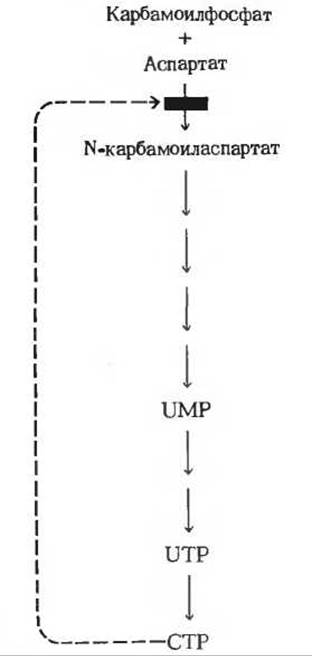
Fig. 22-20. Regulation of CTP biosynthesis via feedback inhibition of aspartate transcarbamoylase by the end product of the pathway. ATP prevents the inhibitory action of CTP.

Fig. 22-21. Effect of the allosteric modulators CTP and ATP on the rate of aspartate conversion to carbamoylaspartate catalyzed by aspartate transcarbamoylase. Note that upon addition of CTP (an allosteric inhibitor of aspartate transcarbamoylase), the $K_m$ for aspartate increases. ATP completely reverses this effect.
Last update: 06/08/2026
Editorial and Educational Adaptation: This material has been compiled based on the primary/original source text. The project team performed an editorial review, corrected technical inaccuracies, structured sections, and adapted the content for an educational format.
What was processed:
- elimination of formatting defects (OCR errors, structural breaks, corrupted characters);
- editorial organization of content;
- standardization of terminology in accordance with academic sources;
- verification of factual statements against the original source text.
All mentions of the author, publication year, and origin of the primary text have been preserved in accordance with the source.