BIOCHEMISTRY - Main Regulators and Biological Fluids of the Human Body - 2016
2. HORMONES
2.12. Practical Part. Study of Qualitative Reactions for Hormones
2.12.2. Qualitative Reactions for Hormones Derived from Amino Acids
Epinephrine (adrenaline) is a hormone of The adrenal medulla. Chemically, epinephrine is a pyrocatechol derivative:
Class="center">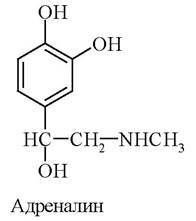
Epinephrine increases metabolic rate and has a pronounced effect on Carbohydrate METABOLISM; its administration causes hyperglycemia and glucosuria due to enhanced Glycogenolysis. The oxidation of epinephrine yields adrenochrome.
Experiment 4. Reaction with Iron (III) Chloride
This method is based on the ability of the pyrocatechol group of epinephrine to form an emerald-green complex compound with iron (III) chloride - FеСI3.
Add 10 drops of a 0.1% epinephrine solution to a test tube, followed by 1 drop of a 1% FеСI3 solution. Observe the appearance of the characteristic coloration. Add 1 drop of concentrated ammonia solution (NН4ОН), and the color of the solution turns red, and then brown.
Record your observations in the report. Conclude whether the corresponding functional group is present in the epinephrine molecule.
Experiment 5. Diazo Reaction
The method is based on the ability of epinephrine to form a red compound with diazobenzenesulfonic acid.
To prepare diazobenzenesulfonic acid, place 3 drops of a 1% sulfanilic acid solution (H2NC6H4SO3H) and 3 drops of a 5% sodium nitrite solution (NaNO2) into a test tube and mix by shaking.
Then, add 5 drops of a 0.1% epinephrine solution and 3 drops of a 10% sodium carbonate solution (Nа2CО3) to the test tube. Mix and observe the liquid turn red.
Record your observations in the report. Conclude regarding the ability of epinephrine to react with diazobenzenesulfonic acid.
Last update: 06/08/2026
Editorial and Educational Adaptation: This material has been compiled based on the primary/original source text. The project team performed an editorial review, corrected technical inaccuracies, structured sections, and adapted the content for an educational format.
What was processed:
- elimination of formatting defects (OCR errors, structural breaks, corrupted characters);
- editorial organization of content;
- standardization of terminology in accordance with academic sources;
- verification of factual statements against the original source text.
All mentions of the author, publication year, and origin of the primary text have been preserved in accordance with the source.