MICROBIOLOGY Study Guide - 2012
CHAPTER 8. MICROBIAL GROWTH
8.3. EFFECT OF SUBSTRATE CONCENTRATION AND METABOLIC PRODUCTS ON THE SPECIFIC GROWTH RATE OF MICROORGANISMS
In batch culture, bacterial growth rate is frequently limited by the availability of a specific nutrient. In laboratory settings, the carbon source (e.g., glucose) often acts as this limiting factor. The relationship between the specific growth rate of a microbial population (μ) and the substrate nutrient concentration (S) was first established by the French biologist Monod. This relationship is described by a saturation curve (Fig. 23) and equation (8.13).
As seen in Fig. 24, the specific growth rate depends on S only at very low substrate concentrations. As the Substrate Concentration increases, the specific growth rate approaches μmах, which represents the theoretical limit of population growth rate that is practically unattainable.
Class="center">
where Ks is the Michaelis constant, numerically equal to the concentration of the limiting substrate at which the growth rate reaches half of its maximum value.

Fig. 24. Dependence of the specific growth rate of microorganisms on the concentration of the growth-limiting substrate
Substrate concentration is not the only factor limiting bacterial growth rate. In their studies on the cultivation of propionic acid Bacteria, N. D. Ierusalimsky and coworkers concluded that the growth rate of these bacteria also depends on the concentration of metabolic products. This relationship is represented by the curve in Fig. 25 and equation (8.14):

where μ0 is the specific growth rate in the absence of growth-limiting factors; P is the concentration of metabolic products; Kp is the Ierusalimsky constant, numerically equal to the concentration of the inhibitory product at which the specific growth rate equals half of the rate without the inhibitory effect of the product.
Since microbial Cell reproduction in a nutrient medium is simultaneously influenced by both substrate concentration and metabolic product concentration, the Monod-Ierusalimsky equation [8.15] has been proposed to account for both factors:

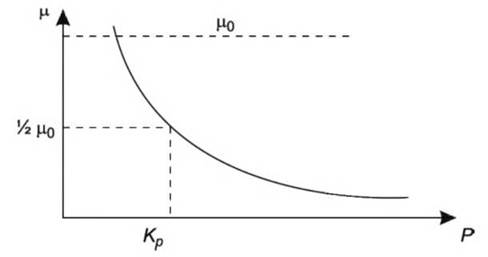
Fig. 25. Dependence of the specific growth rate of the microbial population on the concentration of metabolic products
Last update: 13/08/2026
Editorial and Educational Adaptation: This material has been compiled based on the primary/original source text. The project team performed an editorial review, corrected technical inaccuracies, structured sections, and adapted the content for an educational format.
What was processed:
- elimination of formatting defects (OCR errors, structural breaks, corrupted characters);
- editorial organization of content;
- standardization of terminology in accordance with academic sources;
- verification of factual statements against the original source text.
All mentions of the author, publication year, and origin of the primary text have been preserved in accordance with the source.