Plant Anatomy: A Practical Guide - Paniuta O.O. 2019
Appendices
Microscopic Measurement of Objects
Microscopic measurements of objects are performed using an ocular micrometer (Fig. 1D). To convert the obtained data into micrometers, a stage micrometer is required.
Class="center">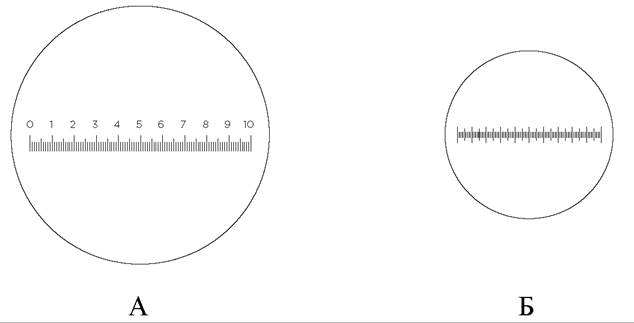
Fig. 1D. Scales of the ocular micrometer (A) and the stage micrometer (B)
An ocular micrometer is a circular Glass disc with a scale of 50-100 divisions etched onto it, which is inserted into the eyepiece. The specimen is placed on the Microscope stage and, looking through the eyepiece, the object and the micrometer scale are aligned so that the object can be measured in ocular micrometer divisions. Then, the specimen is removed, and a stage micrometer with a one-millimeter scale divided into 100 parts is placed on the stage. The value of one division is 10 µm (0.01 mm). The scale of the stage micrometer is aligned with the scale of the ocular micrometer using the same eyepiece and objective lens. Initially, it is best to align the zero points of both scales. For example, at low magnification, 100 Divisions of the stage micrometer (the entire
scale) coincided with 80 divisions of the ocular micrometer. The value of one division of the ocular micrometer for a given microscope objective and eyepiece is determined using the formula:
(А•10)/Б
where А is the number of stage micrometer divisions;
Б is the number of whole ocular micrometer divisions that coincide with the divisions of the stage micrometer;
10 is the value of one stage micrometer division, µm
To determine the true size of an object, its length or width, measured in ocular micrometer divisions, must be multiplied by the value of one ocular micrometer division in micrometers.
Note that the value of one ocular micrometer division differs between low and high microscope magnifications. Therefore, before starting measurements, the division value must be determined for all objective lenses.
Last update: 07/08/2026
Editorial and Educational Adaptation: This material has been compiled based on the primary/original source text. The project team performed an editorial review, corrected technical inaccuracies, structured sections, and adapted the content for an educational format.
What was processed:
- elimination of formatting defects (OCR errors, structural breaks, corrupted characters);
- editorial organization of content;
- standardization of terminology in accordance with academic sources;
- verification of factual statements against the original source text.
All mentions of the author, publication year, and origin of the primary text have been preserved in accordance with the source.