Protein Structure and Function. Application of Bioinformatics Methods - John Rigden 2014
Bioinformatics methods for studying the structure and function of disordered proteins
Prediction of IDP functions
SMOR prediction
As noted above, MoRFs/SLiMs are short functional motifs involved in binding partner molecules, and their presence strongly correlates with local disorder in Proteins (Mohan et al. 2006; Cheng et al. 2007; Vacic et al. 2007). Therefore, detecting such motifs in proteins is of great importance for functional annotation. It has been shown that such regions frequently appear within disorder profiles generated by prediction Methods, particularly PONDR VL-XT: they are recognized as irregular elements and are typically characterized by a dip in the profile (see Fig. 5.4). Although the Structure-function relationship discussed here has not been exhaustively validated statistically, in several cases the local region of irregular structure in the disorder profile and the local functional binding region have been clearly established. Such relationships have been found for the IA3 proteinase inhibitor and p21Cip1 (Vacic et al. 2007), the measles virus nucleoprotein (Bourhis et al. 2005), and many other proteins (Oldfield et al. 2005b; Uversky et al. 2005; Mohan et al. 2006; Vacic et al. 2007).
Class="center">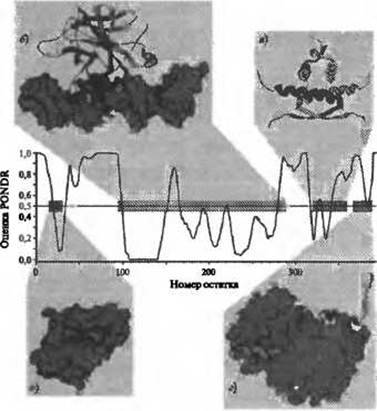
Fig. 5.4. (For the color version of this figure, see the insert.) Prediction of MoRFs/SLiMs in the p53 protein. The disorder profile of this protein was predicted using the PONDR VL-XT algorithm, which is designed to identify Molecular recognition features involved in binding. The positions of irregularities (dips) in the disorder plot coincide with the regions involved in binding Mdm2 (a), DNA (b), and tetramerization (c), as well as with the region in the regulatory domain that binds the S100B(ßß) dimer (a). Binding molecules are shown in blue. (Reprinted with permission from Oldfield 2005b. Copyright 2005 American Chemical Society)
Last update: 06/08/2026
Editorial and Educational Adaptation: This material has been compiled based on the primary/original source text. The project team performed an editorial review, corrected technical inaccuracies, structured sections, and adapted the content for an educational format.
What was processed:
- elimination of formatting defects (OCR errors, structural breaks, corrupted characters);
- editorial organization of content;
- standardization of terminology in accordance with academic sources;
- verification of factual statements against the original source text.
All mentions of the author, publication year, and origin of the primary text have been preserved in accordance with the source.