Protein Structure and Function. Application of Bioinformatics Methods - John Rigden 2014
Comparative Protein Structure Modeling
Steps in Comparative Protein Structure Modeling
Model Evaluation
Once a model has been built, it is essential to validate it for potential errors. The quality of a model can be roughly estimated by the degree of similarity between the target and the template. Sequence identity above 30% allows for a relatively reliable prediction of the expected model accuracy. When sequence identity drops below 30%, this criterion becomes significantly less dependable for assessing the expected accuracy of an individual model. It is precisely in such cases that model assessment Methods are most informative.
Two Types of evaluation can be performed. “Internal” self-consistency evaluation checks whether the model satisfies the constraints used in its calculation, including those based on template Structure or statistical observations. “External” evaluation relies on information that was not used during model calculation.
Evaluating the stereochemistry of a model (such as Bond Lengths, Bond Angles, dihedral angles, and non-bonded atomic distances) using programs like PROCHECK (Laskowski et al. 1993) and WHATCHECK (Hooft et al. 1996) is an example of internal evaluation. Stereochemical errors are rare and less informative than errors identified by external evaluation methods; however, a cluster of chemical errors may indicate that the corresponding region also contains other significant errors (e.g., alignment errors).
External evaluation can, at the very least, answer whether the correct template was used for modeling. Fortunately, an incorrect template can be readily identified using currently available scoring Functions. A more challenging task for scoring functions is to predict unreliable regions within a model. One way to address this problem is to calculate a “pseudo-energy” profile for the model, such as those implemented in PROSA (Sippl 1993) or Verify3D (Eisenberg et al. 1997) methods. The profile reflects the energy for each position of the model (Fig. 3.3). Profile peaks often correspond to model errors. There are several pitfalls in using energy profiles to locate local errors. For instance, a region may be flagged as unreliable simply because it interacts with a mismodelled region (Fiser et al. 2000). Other approaches developed in recent years for evaluating models, either globally (Eramian et al. 2006) or locally (Fasnacht et al. 2007), typically combine various input features. The top-performing Model quality assessment methods employ a straightforward consensus approach in testing, where model reliability is gauged based on its agreement with alternative models, sometimes generated by different methods (Wallner and Elofsson 2005a, 2007). Model assessment is a crucial yet challenging field, as one of its core difficulties represents a circular problem: effective model assessment requires scoring function terms similar to those already employed in generating the high-accuracy models themselves.
Class="center">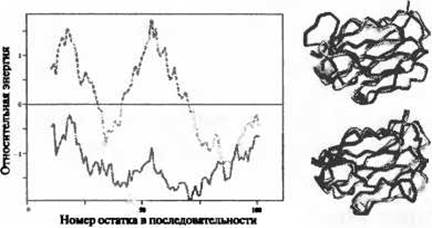
Fig. 3.3. (For the color version of this figure, please see the color insert.) Residue energy as a function of sequence position for two different models of the same protein. Energy was calculated using a statistical pairwise interaction potential. Negative (blue) and positive (red) energy values indicate energetically favorable and unfavorable residue environments, respectively. The energy profiles correspond to the models shown on the right. The less accurate model is positioned above the more accurate one. Individual segments of the models are colored to match their corresponding energy profiles. The actual experimental structure is shown in gray.
Last update: 06/08/2026
Editorial and Educational Adaptation: This material has been compiled based on the primary/original source text. The project team performed an editorial review, corrected technical inaccuracies, structured sections, and adapted the content for an educational format.
What was processed:
- elimination of formatting defects (OCR errors, structural breaks, corrupted characters);
- editorial organization of content;
- standardization of terminology in accordance with academic sources;
- verification of factual statements against the original source text.
All mentions of the author, publication year, and origin of the primary text have been preserved in accordance with the source.